
Updated 7 July 2022 at 16:58 IST
In a first, astronomers peer furthest in time to observe slow spin of distant galaxy
The target galaxy named JD1 was formed just about 250 million years after the Big Bang and was significantly smaller than the Milky Way, astronomers concluded.
- Science News
- 2 min read

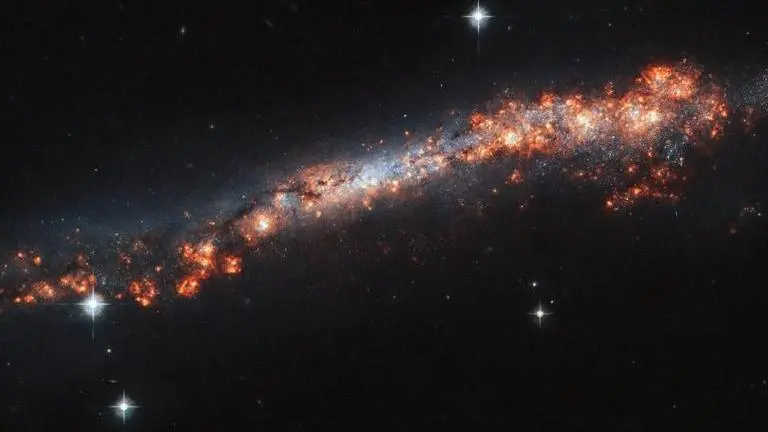
A team of astronomers, including those from Cambridge University, has observed the slow spin of a distant galaxy for the first time ever using the Chile-based Atacama Large Millimeter/submillimeter Array (ALMA) telescope. What's more, is that the experts have also peered the furthest back in time as the target galaxy's light first emerged when the Universe was only 550 million years old, just 4% of its present age.
"This is by far the furthest back in time we have been able to detect a galaxy’s spin", co-author Professor Richard Ellis from University College London (UCL) said in a statement, adding, "It allows us to chart the development of rotating galaxies over 96% of cosmic history-- rotations that started slowly initially, but became more rapid as the Universe aged".
Astronomers measure the age and mass of the galaxy
The astronomers were also able to measure the target galaxy MACS1149-JD1's (JD1) age, mass, spin, and distance from the Milky Way. By studying the subtle variations in the wavelengths of JD1's light, they concluded that the galaxy was disc-shaped and rotating at a speed of 50 kilometres a second. Besides, these wavelengths also helped them determine the galaxy's age which is believed to be 300 million years old, meaning it formed 250 million years after the Big Bang, the explosion that birthed the universe.
"We see that, 300 million years after massive molecular clouds condensed and fused into stars, a galactic disk has developed and the galaxy has acquired a shape and rotation", co-author Nicolas Laporte, from Cambridge’s Kavli Institute for Cosmology said. According to the study, which has been published in The Astrophysical Journal Letters, the researchers studied the redshift variations of the galaxy to measure its age and its overall size.
Advertisement
A redshift is a phenomenon when a moving object emits light and that light is stretched after travelling large distances. Owing to this stretching of light, its wavelength 'shifts' toward the red part of the light spectrum. Interestingly, this redshift variation revealed that JD1 measured just 3,000 light-years across as compared to the Milky Way (1,00,000 light-years across) and that its total mass was equivalent to 1-2 billion times the mass of the Sun. Apart from JD1, the scientists determine the age of five more galaxies and concluded that the first stars lit up around 200 to 300 million years after the Big Bang.
Published By : Harsh Vardhan
Published On: 7 July 2022 at 16:57 IST