
India on track to become 4th nation on the Moon as Russia delays lunar mission
Russia's Luna 25 mission will now be launched to the Moon in August atop the Soyuz-2.1b carrier rocket from the Vostochny space center.
- Science News
- 3 min read

;'%3e%3cpath%20d='m8,15.99c4.41,0,7.99-3.58,7.99-7.99S12.41,0,8,0,0,3.59,0,8s3.58,7.99,7.99,7.99Z'%20style='stroke:%23fff;%20stroke-miterlimit:10;%20stroke-width:.02px;'/%3e%3cpath%20d='m3.08,3.37l3.82,5.11-3.84,4.15h.87l3.37-3.64,2.72,3.64h2.94l-4.04-5.39,3.58-3.87h-.86l-3.1,3.35-2.5-3.35h-2.94Zm1.27.64h1.35l5.97,7.99h-1.35l-5.97-7.99Z'%20style='fill:%23fff;'/%3e%3c/g%3e%3c/svg%3e)


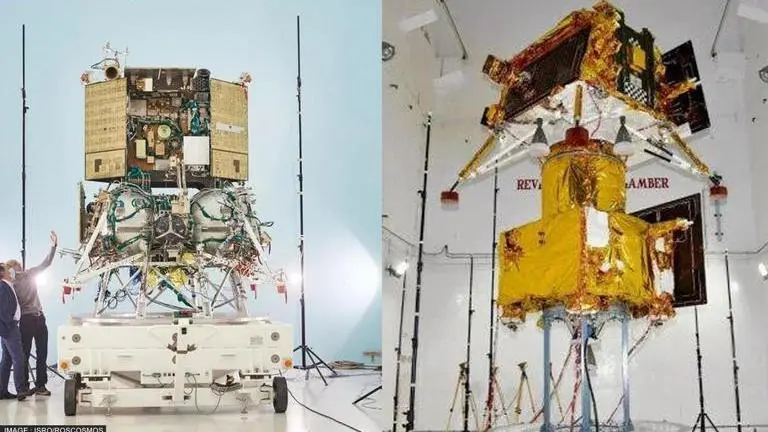
India has the opportunity to beat Russia to the Moon as the latter has decided to postpone the launch of its first lunar mission until August of this year. Russia's Luna 25 was scheduled to launch on July 13 but it hasn't been completed yet. ISRO, on the other hand, is on track for a mid-July launch of Chandrayaan-3. The spokesperson of Roscosmos, the Russian space agency, said that the developers decided it would be 'appropriate' to launch the lander in August. "Statistic simulation of the mission’s key stage-- a soft landing on the lunar surface -- is now nearing completion," he said per TASS News.

(The Luna-25 lander; Image: Roscosmos)
When it is complete, the Luna 25 lander will be launched atop the Soyuz-2.1b carrier rocket from the Vostochny space center. Notably, it would be the first lunar mission of modern Russia. It launched its last lunar endeavour Luna 24 as USSR in 1976. That mission fetched about 170 grams of soil from the Moon.

(Artist's representation of the Luna 25 lander on the Moon; Image: NASA)
Advertisement
A soft landing on the Moon is a feat that only three nations -- the US, China and the USSR-- have achieved. It is during the landing when most of the missions fail as the landers experience a number of factors such as high radiation, lunar dust and communication blackout, making it equivalent to driving with blindfolds on. ISRO's Chandryaan-2 lost communication just around 2 km above the surface. Japan's private firm ispace also lost its lander in April this year when its HAKUTO-R lander faced a software glitch 5 km above the surface and crashed.

(Chandrayaan-3 lander integrated with propulsion module; Image: ISRO)
Advertisement
ISRO is trying another shot at the Moon with its Chandrayaan-3 mission which is likely to launch around mid-July. It will be a follow-up mission of Chandrayaan-2 and includes the lander-rover combination but not an orbiter like its predecessor. ISRO intends to use the same orbiter if it successfully lands on the Moon. It will be launched aboard the LVM3 rocket from Sriharikota. Chandrayaan-3 is designed to operate for roughly 14 Earth days (one lunar day).
As for the Luna 25 lander, it will land at the Boguslawsky crater on the Moon's south pole and operate for about a year. Weighing approximately 800 kg, the lander will use its suite of instruments to study the composition of the polar regolith (soil) and investigate the plasma and dust components of the Moon's exosphere at the south pole.
Russia's Moon mission was initially planned to launch in 2022 but a few technical issues along with its war with Ukraine caused the delay. Notably, the European Space Agency (ESA) was also a partner in the Luna 25 mission but it decided to end its participation after the war broke out. Roscosmos chief Yuri Borisov, however, said that the delay from September 2022 to 2023 was due to the underperformance of a device that would help in a soft landing on the Moon. The lander is being manufactured by a firm called Lavochkin Research and Production Association and was shipped to the launch facility earlier this month.