
Updated 7 June 2022 at 15:07 IST
International Space Station's living condition is worsening since Expedition 55: Expert
International Space Station's living conditions have worsened in the last few years due to an increase in bacterial levels above normal, said a Russian expert.
- Science News
- 2 min read

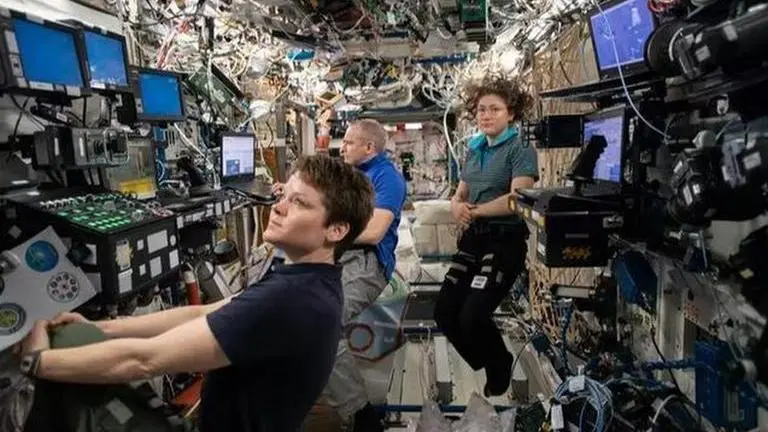
The number of microorganisms aboard the International Space Station (ISS) has surpassed the normal levels as they have been detected in 65% of all samples, revealed Oleg Orlov, Director of the Institute of Biomedical Problems of the Russian Academy of Sciences (RAS). According to a report by Russian news agency TASS, he also revealed that this has caused the living conditions of the space station to worsen since Expedition 55, which took off in 2018. The orbital outpost has been hosting astronauts for the last two decades although scientists believe that it has long crossed its expected lifespan.
How did the bacteria levels grow aboard the ISS?
Speaking at a joint meeting of the RAS’ Space Council and the Presidium of the Scientific and Technical Council of Roscosmos this week, Orlov explained that a large amount of bacteria is being carried to the ISS during crew and cargo missions, causing their number to grow. He said that due to this, the growth in levels of even the pathogens or the disease-causing bacteria is "inevitable".
He further noted that these microorganisms are adapting to the new environment in space due to which even the preventive and control measures are unable to contain the biological pollution. Orlov revealed that most of the microorganisms found aboard the ISS belong to third and fourth pathogenicity groups such as staphylococci and streptococci. Additionally, the contamination is also being caused by bacteria that could cause allergies or upper respiratory tract disease and fungal species, also capable of causing allergies, have also been detected. What's concerning, is that the detected microorganisms not only pose threat to astronaut health but also to the necessary equipment inside the orbital outpost.
What do space agencies do to prevent microorganisms spread?
The most preferred method to prevent the spread of microorganisms is to put astronauts along with the cargo being sent to space in isolation. Putting astronauts under quarantine is a common tradition so as to ensure that the ISS visitors are not incubating an illness and won't carry them to space. Astronauts returning from the space station are also isolated for at least a couple of weeks to allow them to adjust to the conditions on Earth. For example, astronauts of the Apollo missions were isolated after they returned from the Moon as scientists feared they might have brought some "Moon bugs".
Advertisement
Published By : Harsh Vardhan
Published On: 7 June 2022 at 15:07 IST