
ISRO reveals when Chandrayaan-3 will begin landing on the Moon
ISRO said the powered descent of Chandrayaan-3's Vikram lander on the surface of the Moon is expected to commence on August 23 at around 5:45 pm.
- Science News
- 2 min read

;'%3e%3cpath%20d='m8,15.99c4.41,0,7.99-3.58,7.99-7.99S12.41,0,8,0,0,3.59,0,8s3.58,7.99,7.99,7.99Z'%20style='stroke:%23fff;%20stroke-miterlimit:10;%20stroke-width:.02px;'/%3e%3cpath%20d='m3.08,3.37l3.82,5.11-3.84,4.15h.87l3.37-3.64,2.72,3.64h2.94l-4.04-5.39,3.58-3.87h-.86l-3.1,3.35-2.5-3.35h-2.94Zm1.27.64h1.35l5.97,7.99h-1.35l-5.97-7.99Z'%20style='fill:%23fff;'/%3e%3c/g%3e%3c/svg%3e)


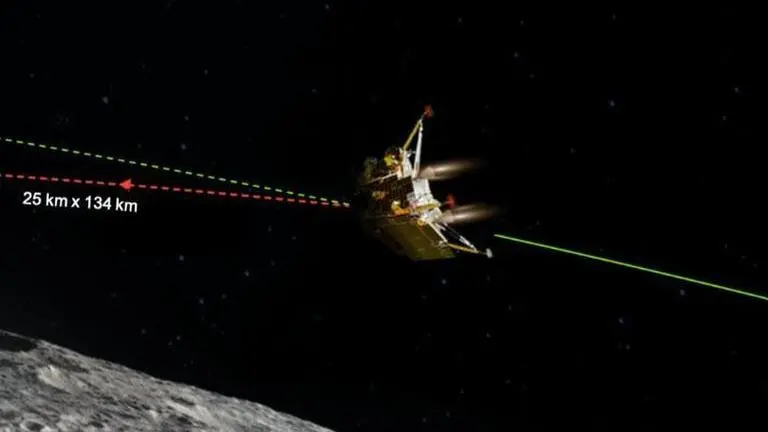
The second and final deboosting operation of India's Moon mission Chandrayaan-3 successfully completed Sunday morning, Indian Space Research Organisation (ISRO) informed. The space agency said the powered descent of Chandrayaan-3's Vikram lander on the surface of the Moon is expected to commence on August 23 at around 5:45 pm. The first de-boosting operation was conducted on Friday, August 18.
According to ISRO, the Vikram lander has finally placed itself in an orbit where the closest point to the Moon is 25 km and the farthest is 134 km, bringing it closer to its intended soft-landing on the surface of the moon. “The module would undergo internal checks and await the sun-rise at the designated landing site,” the Indian space agency informed.
Chandrayaan-3 Mission:
— ISRO (@isro) August 19, 2023
The second and final deboosting operation has successfully reduced the LM orbit to 25 km x 134 km.
The module would undergo internal checks and await the sun-rise at the designated landing site.
The powered descent is expected to commence on August… pic.twitter.com/7ygrlW8GQ5
After missing a mark in 2019, when the Chandrayaan-2 crashed on the surface of the moon, Chandrayaan-3’s moon landing will make India the historic fourth country to have achieved this feat after the United States, Russia, and China.
Chandrayaan-3 and its journey to the moon
Chandrayaan-3, which set off from the Earth on July 14 from the Satish Dhawan Space Centre in Sriharikota, entered the lunar orbit on August 5. Following this, the orbit reduction manoeuvres were carried out on the satellite on August 6, 9, 14 and 16, ahead of the separation of Vikran Lander from its propulsion module on August 17, in the runup to the landing on August 23.
Advertisement
Chandrayaan-3 is a follow-on mission to Chandrayaan-2 to demonstrate end-to-end capability in safe landing and roving on the lunar surface. The mission’s objective is to conduct in-situ scientific experiments.