
ISRO successfully launches and injects Aditya-L1 into Earth’s Halo orbit
ISRO has placed the Aditya L-1 probe, India's first Sun probe, into Earth's Halo orbit at a distance of 19,500 kilometers away from Earth.
- Science News
- 2 min read

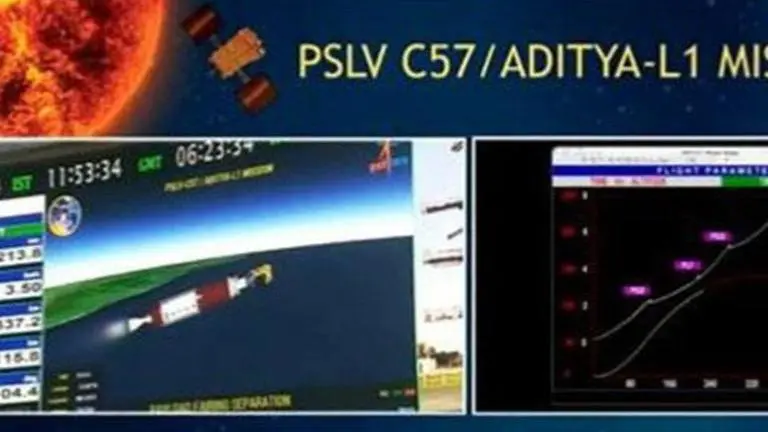
In a historic milestone for India's space exploration efforts, the Indian Space Research Organisation (ISRO) announced that the launch of the Aditya-L1 spacecraft, India's first solar observatory, was successful and was carried into its intended HALO orbit on September 2.
The spacecraft was placed at an apogee of 19,500 kilometres, the farthest point from Earth from where it will initiate its initial manoeuvres and reach the perigee point just 235 kilometres from Earth before escaping Earth's gravitational pull. It will then embark on its 1.5 million-kilometre journey to the Sun-Earth System's first Lagrange point.
The launch took place at 11:50 AM from the Satish Dhawan Space Centre in Sriharikota, Andhra Pradesh. Following liftoff, the vehicle executed a precisely planned trajectory, placing the Aditya-L1 satellite on its journey towards the L1 point. This destination was strategically chosen to enable continuous solar observation without the hindrance of eclipses or occultation.
The Aditya-L1 mission is poised to provide insights into the Sun's behaviour, with seven distinct payloads onboard. Four of these instruments will meticulously observe solar light, while the remaining three will measure in-situ parameters of plasma and magnetic fields. Notably, the Visible Emission Line Coronagraph (VELC), a technically challenging payload, will play a crucial role in capturing the faint solar corona, which is typically visible only during a total solar eclipse.
Advertisement
VELC was meticulously developed and calibrated at the Indian Institute of Astrophysics' CREST campus in Hoskote, in collaboration with ISRO. Its precision will enable scientists to monitor solar activities in real time, aiding the understanding of space weather dynamics and solar eruptive events.
The objectives of India's solar mission extend to studying the physics of the solar corona and its heating mechanisms, solar wind acceleration, the dynamics of the solar atmosphere, solar wind distribution, temperature anisotropy, and the origin of Coronal Mass Ejections (CME) and solar flares. This mission will also contribute to a deeper comprehension of near-Earth space weather, a crucial aspect of modern space exploration.
Advertisement
The successful launch of Aditya-L1 follows India's recent achievement in lunar exploration, with the historic landing of the Chandrayaan-3 lander on the lunar surface on August 23rd. India became the first country to land on the Lunar South Pole. The mission objectives included a safe and soft landing on the lunar surface, rover operations, and in-situ scientific experiments, building on the lessons learned from the Chandrayaan-2 mission in 2019.