
James Webb Space Telescope delivers largest image of the cosmos after its deepest one
The James Webb Space Telescope's largest image of the cosmos features thousands of galaxies including some almost as old as the universe itself.
- Science News
- 2 min read

;'%3e%3cpath%20d='m8,15.99c4.41,0,7.99-3.58,7.99-7.99S12.41,0,8,0,0,3.59,0,8s3.58,7.99,7.99,7.99Z'%20style='stroke:%23fff;%20stroke-miterlimit:10;%20stroke-width:.02px;'/%3e%3cpath%20d='m3.08,3.37l3.82,5.11-3.84,4.15h.87l3.37-3.64,2.72,3.64h2.94l-4.04-5.39,3.58-3.87h-.86l-3.1,3.35-2.5-3.35h-2.94Zm1.27.64h1.35l5.97,7.99h-1.35l-5.97-7.99Z'%20style='fill:%23fff;'/%3e%3c/g%3e%3c/svg%3e)


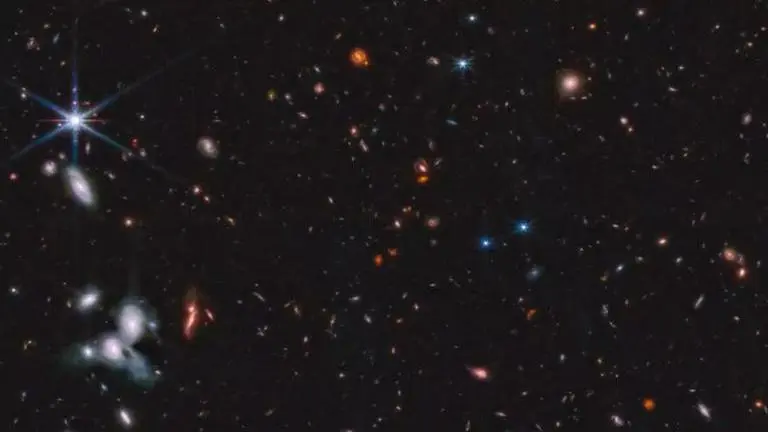
Piling on the treasure trove of data, the NASA-ESA-CSA’s James Webb Space Telescope has delivered again. This time, the world’s most powerful observatory’s data has been used to produce the largest image of our universe to date. Developed using Webb’s Near-Infrared Camera (NIRCam) and Mid-Infrared Imaging (MIRI) instruments, the picture is a mosaic of 690 individual frames in a small patch of sky near the handle of the Big Dipper constellation.
The picture is named epoch 1 and was released by the Cosmic Evolution Early Release Science Survey (CEERS) collaboration after observation in near-infrared and mid-infrared wavelengths of light. “Epoch 1 contains four of our 10 total planned images that were taken with NIRCam in June of 2022 with the remaining observations scheduled for December 2022,” the experts said in the CEERS report.
More about the new images
The image features highly redshifted galaxies, meaning the light emerging from the galaxies have shifted from visible to infrared wavelengths. One such galaxy named Maisie's (zoomed in on the image above) is being considered one of the oldest galaxies ever discovered.

(Maisie's galaxy zoomed in; Image: NASA/STScI/CEERS)
Advertisement
“If Maisie's galaxy is confirmed to be at a redshift greater than 11.8, with future observations, that would mean that we're seeing this galaxy as it was less than 400 million years after the Big Bang”, the report further said. As you can see, the picture is brimming with galaxies and the astronomers even highlighted some of their favourite objects captured by Webb.
In the first zoomed-in object in the image below, there is a spiral galaxy where a large number of blue star-forming clumps and star clusters are revealed using the NIRCam. The second box shows another galaxy older than the first one where several smaller galaxies were found forming an arc in the sky. Both the third and fourth boxes feature interacting galaxies, however, the latter has two spiral galaxies interacting with each other.
Advertisement

(Image: NASA/STScI/CEERS)
Interestingly, the astronomers also discovered a supernova nestled between these galaxies which have been pointed with an arrow. The fifth and the sixth boxes also feature zoomed-in galaxies that showcase Webb’s ability to photograph such distant objects.