
James Webb Space Telescope's mirrors align 1st starlight in a hexagon, reveals NASA
The James Webb Space Telescope has brought the 18 unfocused images of a star into a hexagonal formation by moving each of its 18 primary mirror segments.
- Science News
- 2 min read

;'%3e%3cpath%20d='m8,15.99c4.41,0,7.99-3.58,7.99-7.99S12.41,0,8,0,0,3.59,0,8s3.58,7.99,7.99,7.99Z'%20style='stroke:%23fff;%20stroke-miterlimit:10;%20stroke-width:.02px;'/%3e%3cpath%20d='m3.08,3.37l3.82,5.11-3.84,4.15h.87l3.37-3.64,2.72,3.64h2.94l-4.04-5.39,3.58-3.87h-.86l-3.1,3.35-2.5-3.35h-2.94Zm1.27.64h1.35l5.97,7.99h-1.35l-5.97-7.99Z'%20style='fill:%23fff;'/%3e%3c/g%3e%3c/svg%3e)


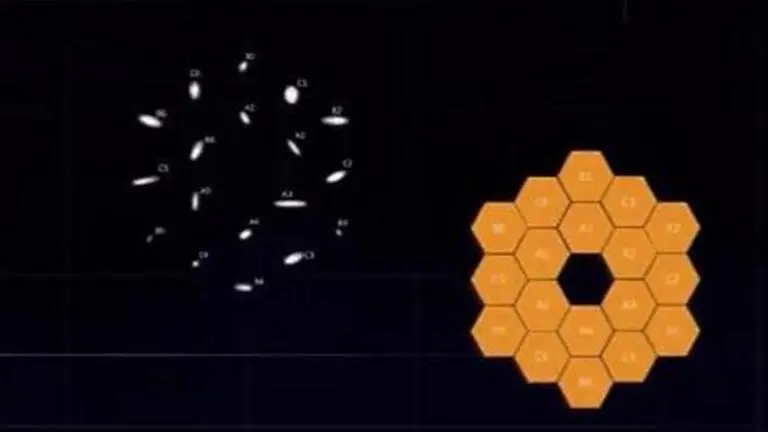
Engineers handling the James Webb Space Telescope have achieved another milestone as they recently completed the ‘Segment Image Identification’ phase of mirror alignment. With the completion of the first phase, the telescope has brought the 18 unfocused images of a star into a hexagonal formation by moving each of its 18 primary mirror segments. As of now, Webb is in its commissioning phase and has two of its four major instruments turned on.
He(X)agon marks the spots 🏴☠️
— NASA Webb Telescope (@NASAWebb) February 18, 2022
Last week, 18 spots helped confirm that each of Webb's mirror segments can see starlight. Now we've arranged those dots into our primary mirror shape, completing the first of Webb's mirror alignment phases: https://t.co/T3pf68Cfvj #UnfoldTheUniverse pic.twitter.com/dYzPqg0EJv

(The image above shows 18 dots of starlight, random (left) and arranged (right) and each of them, on the right-hand side, corresponds to the hexagonal mirrors that captured them. Image: NASA)
NASA said that the alignment process has moved on to its second phase called “Segment Alignment”, wherein the mission team would make each individual dot of starlight more focused. This would be done by correcting large positioning errors of the mirror segments and updating the alignment of the secondary mirror. It is worth noting that, earlier this month, the telescope had taken the first-ever images using its mirrors although all of them were out of focus.
⚫️ Our team first chose a bright, isolated star called HD 84406. Over ~25 hours, Webb was repointed to 156 positions around the star's predicted location, generating 1560 images with NIRCam’s 10 detectors. This is just the center of an image mosaic with over 2 billion pixels! pic.twitter.com/XfaIJcDghF
— NASA Webb Telescope (@NASAWebb) February 11, 2022
When the second phase-- “Segment Alignment” is complete, the engineers would move on to the third-- “Image Stacking,” where they would bring the 18 spots of light on top of each other. Matthew Lallo, systems scientist and Telescopes Branch manager at the Space Telescope Science Institute said as per NASA's statement, 'We steer the segment dots into this array so that they have the same relative locations as the physical mirrors. During global alignment and Image Stacking, this familiar arrangement gives the wavefront team an intuitive and natural way of visualizing changes in the segment spots in the context of the entire primary mirror. We can now actually watch the primary mirror slowly form into its precise, intended shape!"
Advertisement
Webb turns on its instruments
In a recent achievement, NASA had locked in its second instrument-- the Fine Guidance Sensor (FGS)-- onto the star HD 84406 to align its mirrors using the latter as a reference point. Before turning on the FGS, the telescope had had the Near Infrared Camera (NIRCam) turned on, which helped it to capture the first-ever image of the star. As for the next step, Webb would undergo a few more weeks of the alignment process, before starting the observations later this year.