
Key objectives and components for ISRO's Gaganyaan test scheduled for October 21
ISRO's first TV-D1 test flight to advance Gaganyaan goals in space exploration, demonstrating Crew Escape System and the Launch vehicle’s performance.
- Science News
- 4 min read

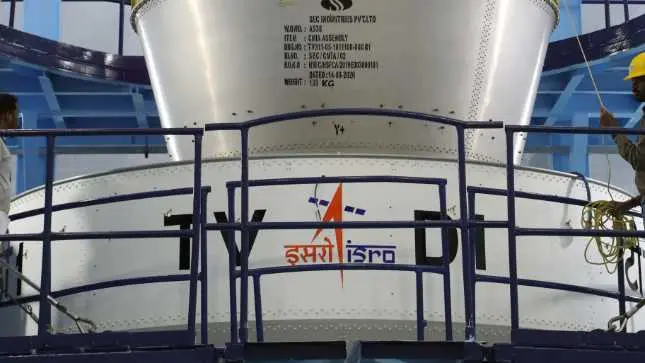
The Indian Space Research Organization (ISRO) is set to conduct its first test flight for the ambitious Gaganyaan mission. This aims to achieve the initial set of results and evaluate the subsystems and the launch vehicle for future missions. The Test Vehicle Abort Mission-1 (TV-D1), the first of four uncrewed demonstration flights, will take place at the Satish Dhawan Space Centre in Sriharikota. The test flight is scheduled for October 21, 2023, between 7 am and 9 am IST.
The primary objective of the TV-D1 mission is to demonstrate the performance of the Crew Escape System (CES).
Mission objectives of ISRO’s upcoming Gaganyaan test
- Subsystem evaluation - rigorous flight testing and evaluation of the Test Vehicle's subsystems, as per ISRO officials will constitute a primary mission objective.
- Comprehensive CES evaluation - thorough evaluation of the Crew Escape System, including its diverse separation mechanisms, is too a critical focal point of the October 21 test.
- Crew module characterisation - ISRO’s upcoming mission seeks to demonstrate the characteristics of the Crew Module and its deceleration systems at higher altitudes, followed by a secure recovery.
The Gaganyaan TV-D1 mission is designed to execute an ‘in-flight abort demonstration’ of the Crew Escape System (CES) at a Mach number of 1.2, operating at an altitude of 11.7 kilometres with a flight path angle of 60 degrees. This system is designed to quickly separate the crew module from the rocket in case of an imminent failure or off-nominal flight.
The dynamic pressure during this phase will be around 22.6 kilopascals, to demonstrate the ‘robustness’ of the system. The critical phases of the mission have been planned by ISRO. This test flight will simulate an abort condition during the ascent trajectory, a scenario that could be encountered in the actual Gaganyaan mission.
Advertisement
Firstly, the Crew Module (CM) will separate from the CES at Mach 0.5, occurring at an altitude of 17 kilometres with a dynamic pressure ranging from 2 to 3 kilopascals. Following this, the drogue parachute deployment is slated to take place at an altitude of 16.7 kilometres, ensuring a controlled descent. Finally, the main parachute will be deployed at an altitude of less than 2.5 kilometres, marking the culmination of the abort mission.
Key components: crew module and test vehicle
The Crew Module (CM) is the core component of the Gaganyaan mission. It houses astronauts in a pressurised, Earth-like atmosphere. For the TV-D1 mission, the CM is an unpressurized version that matches the size and mass specifications of the actual Gaganyaan CM. It encapsulates all the systems necessary for deceleration and recovery. The CM is extensively instrumented to capture flight data for system evaluation. Post-touchdown, the CM will be recovered from the Bay of Bengal, utilising a dedicated vessel and diving team from the Indian Navy.
Advertisement
The Test Vehicle, a single-stage liquid rocket developed for this abort mission, is in its final stages of preparation. It incorporates the Crew Module (CM) and Crew Escape Systems (CES) with their fast-acting solid motors. Additional components include the CM fairing (CMF) and Interface Adapters. The flight will replicate the abort condition during the ascent trajectory, with CES and CM separation occurring at an altitude of approximately 17 kilometres. Subsequently, the autonomous abort sequence will unfold, culminating in the safe touchdown of the CM in the sea, about 10 kilometres from the coast of Sriharikota.

The TV-D1 mission is a crucial part of the Gaganyaan program, which envisions launching a human crew to an orbit of 400 km and safely returning them to Earth.The successful completion of the TV-D1 test flight will bring India one step closer to its ambitious goals in space exploration. This includes setting up an Indian Space Station by 2035 and sending an Indian astronaut to the moon by 2040.
For those interested in witnessing this historic event, ISRO will be live-streaming the test flight through various platforms, including its official website, Facebook, and YouTube. The public can also view the launch from the viewing gallery at the spaceport in Sriharikota.