
Landing on the Moon Vs landing on Mars - which one is easier?
Moon and Mars missions have seen several failed attempts to explore these worlds. ISRO's Chandrayaan-3 will make another attempt to investigate the Moon.
- Science News
- 5 min read

ISRO will face its biggest test on August 23, when the Vikram lander of the Chandrayaan-3 mission makes its descent for a soft landing on the Moon's South Pole. The lander is currently orbiting the Moon in a 25 km X 134 km orbit after completing the second deboosting maneuver on August 20. Notably, the Chandrayaan-2 mission, launched in 2019, also cleared these tense phases but crashed on the Moon after losing contact with ground stations.

(Chandrayaan-3 Vikram lander; Image: ISRO)
This time around, ISRO is confident that the landing will be successful, however, the recent missions which the Moon has killed do raise some doubts. For several decades, humans have been landing probes on Moon and our second preferred destination - Mars. The first success came in 1969 when NASA landed two astronauts on the lunar surface followed by Mars 3, the lander which made the first touchdown on the red planet in 1971.
The successes were coupled with many failed attempts on both worlds, something which explains how complicated space really is. But, which one is more difficult to tame, the Moon or Mars?
Advertisement
Which one's easier to land on?
None. Both the Moon and Mars pose their own challenges which could be related to distance from Earth or its atmosphere. While NASA has successfully attempted landing near the Moon's equatorial regions, no country has ever dared to land on the South Pole of the Moon until now.
Apart from Chandrayaan-3, Japan's private firm ispace and Russian space agency Roscosmos sent their landers to the South Pole but failed to land. But what are the challenges that the Moon poses? Well, first of all, the Moon has an extremely thin atmosphere called the exosphere, which is nothing compared to the Earth's. This eliminates the use of parachutes to ensure a safe landing on the surface. The mission controllers have to solely rely on the lander's engines and use the right amount of thrust to steer it over the Moon.
Advertisement
Russia's Luna-25 mission ended on August 20 due to a malfunction in the engine of the lander as it operated for 127 seconds instead of 84 seconds and sent it spinning out of control before a crash.

(The Luna-25 lander; Image: NPO Lavochkina/Roscosmos
Another major challenge is identifying the proper landing site for a probe. Like Earth, the Moon does not have navigation systems that could help in pinpointing safe locations for a touchdown. Keeping communications intact throughout the entire landing sequence is another major hurdle, something which swallowed Chandrayaan-2 and ispace's HAKUTO-R landing missions.
Chandrayaan-2, which was launched on July 22, 2019, lost communication with the mission team when it was just a couple of km above the lunar surface and made a hard landing. Israel's Beresheet mission, the first from the country, also ended in failure after its launch on February 22, 2019, during the landing attempt as communication was lost. The HAKUTO-R mission met the same ending on April 25 after the lander miscalculated the altitude and spent all its fuel in orbit.

(Artist's representation of the HAKUTO lander. Image: ispace)
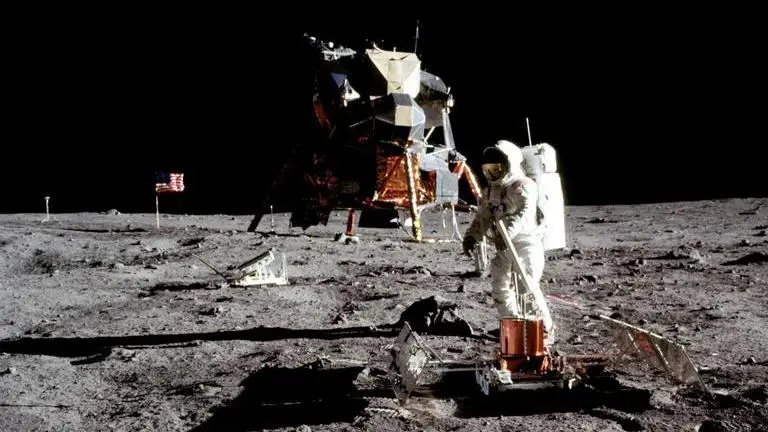
Some might even question if humans actually landed on the Moon during the Apollo program considering the difficulties in acing a safe touchdown today. What's worth noting, however, is that the men who flew to the Moon piloted the landing module. Currently, all that scientists can do is feed instructions into the robotic landers and hope for a safe landing using the onboard computers. According to a 2019 data from NASA, only 60% of the Moon missions were successful in the last six decades. Out of the total (109), 61 were successful and 48 failed.
Landing on Mars could be equally terrifying as factors such as signal loss and atmospheric density could jeopardise the mission. One such example of a failed mission on Mars is the Soviet Union's Mars 2 which launched in 1970. It is remembered as the first man-made object to touch down on Mars although unsuccessfully. The mission failed after the lander crashed during a huge dust storm.
The next mission, Mars 3, went a step ahead and landed successfully on Mars on December 2, 1971, a year after its launch. This mission also failed after contact was lost with the lander just 20 seconds after it started taking pictures of the planet's terrain.
The Earth and Mars are separated by a distance of 400 million km which causes delays in signals back and forth between the planets. According to the European Space Agency (ESA), the signal delay was 13 minutes, 48 seconds during the Entry, Descent and Landing (EDL) of the Curiosity rover.
Mars, however, gives an advantage over the Moon. Although its atmosphere is 100 times thinner than that of Earth, huge parachutes can be used to slow down the lander. NASA's Viking landers and Curiosity and Perseverance rovers have successfully landed on Mars using huge parachutes. All in all, space is unforgiving and even the slightest error can send years of hard work and millions of dollars down the drain. However, major space agencies still have a number of missions planned to the Moon and Mars as they seek to make humans a multi-planetary species.