
Updated 13 June 2022 at 20:25 IST
Mars orbiter beams intriguing image featuring crater that hosted water 4 billion years ago
ESA's Mars Express orbiter has transmitted a new photograph featuring a crater in the Aonia Terra region where once water flowed around 4 billion years ago.
- Science News
- 2 min read

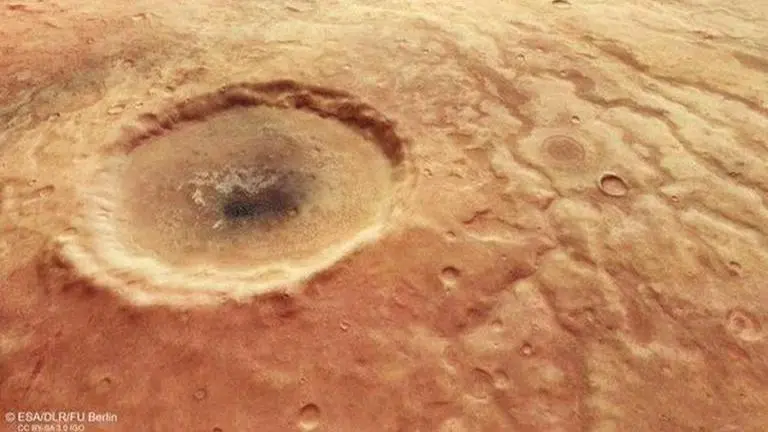
The European Space Agency (ESA) is back with another exciting image that will surely induce pareidolia, the ability that enables us to see recognizable shapes in objects. This image below was beamed to Earth by ESA's Mars Express orbiter and the crater featured in the picture eerily resembles a human eye with veins next to it to some extent. However, what's most exciting about the crater is that some of its characteristics were shaped by water that once flowed over the Martian surface.
📷 Our #WeekInImages 6-10 June 👉 https://t.co/GnnVIKuf7q pic.twitter.com/YYE7EnvOlF
— ESA (@esa) June 12, 2022
Water first, lava later...

(Topography of Aonia Terra shown in different colours; Image; ESA)
The crater and its surrounding area are located in the region named Aonia Terra which is known for its impressive craters. The region has been named after a feature called Aonia, a dark patch on the surface of Mars that can be seen from Earth, even with rudimentary telescopes. While the crater itself is unnamed, ESA says that the region around it, such as the vein-like features (in the image above) are likely to have carried liquid water across the surface of Mars around 3.5 to 4 billion years ago.
Interestingly, scientists believe that the channels must have also been filled with lava, something which explains why the channels appear to be partly filled with a dark material, and in some places, seem to actually be raised above the surrounding land.
Advertisement
The different colours in the photograph depict a variety of materials from which the area is made of. According to the agency, the South part of the crater (seen on the lower left of the image) is warm red but is darker brownish-grey closer to the crater, which, along with the buttes, suggests that the land was gradually worn away by water, wind or ice.
"Inside the crater, a dark dune field rests on a lighter surface. Upon closer inspection, it becomes apparent that the crater is filled with more buttes and cone-shaped hills. These are evidence that many different materials accumulated inside the crater", ESA detailed in its report.
Published By : Harsh Vardhan
Published On: 13 June 2022 at 20:25 IST