
Meteorite from Mars offers new insights on red planet's past, and its not what we knew
Curtin University exstudying a piece of a Martian meteorite that was discovered on Earth in the Sahara Desert of Morocco in 2011 and was first reported in 2013.
- Science News
- 3 min read

;'%3e%3cpath%20d='m8,15.99c4.41,0,7.99-3.58,7.99-7.99S12.41,0,8,0,0,3.59,0,8s3.58,7.99,7.99,7.99Z'%20style='stroke:%23fff;%20stroke-miterlimit:10;%20stroke-width:.02px;'/%3e%3cpath%20d='m3.08,3.37l3.82,5.11-3.84,4.15h.87l3.37-3.64,2.72,3.64h2.94l-4.04-5.39,3.58-3.87h-.86l-3.1,3.35-2.5-3.35h-2.94Zm1.27.64h1.35l5.97,7.99h-1.35l-5.97-7.99Z'%20style='fill:%23fff;'/%3e%3c/g%3e%3c/svg%3e)


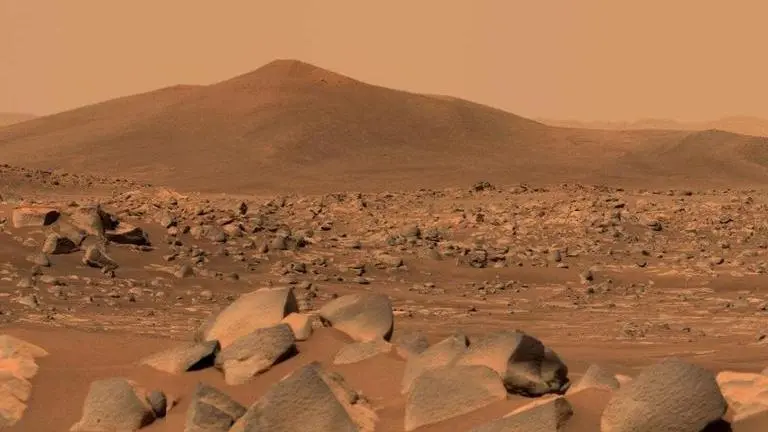
Scientists are now one step closer to determining exactly when Mars was habitable as researchers from Australia-based Curtin University claim to have found evidence for the same. The team of experts was studying a piece of a Martian meteorite that was discovered on Earth in the Sahara Desert of Morocco in 2011 and was first reported in 2013. Named NWA 7034 or 'black beauty', the rock from Mars weighs 320 grams and carries information about the red planet's early life, the experts reported in their study in the journal Science Advances.

(NWA 7034 or 'black beauty'; Image: NASA)
'It's a one-off gift from Mars': Lead author
According to the lead author Morgan Cox, this piece of rock which is a collection of broken rock fragments and minerals, mostly basalt, is a treasure trove about the damage caused on Mars during meteorite impacts. "This grain is truly a one-off gift from the Red Planet. High-pressure shock deformation has not previously been found in any minerals from Black Beauty. This discovery of shock damage in a 4.45 billion-year-old Martian zircon provides new evidence of dynamic processes that affected the surface of early Mars", Cox said in Curtin University's report.
The 'shock deformation' Cox is talking about is basically the microscopic damage caused in the rock by the shock waves created during an impact. The rock examined during this study was reported to have evidence of the mineral zircon which gets crystallized from magma and is said to be a "geochronometer", meaning it records how much time has passed. Experts say that 'shocked' zircons on Earth are only found in impact craters such as Vredefort in South Africa, Sudbury in Canada and Chicxulub in Mexico. The last one is where the dinosaur-killing struck leading to mass extinction.
Advertisement
Shedding more light on the same, co-author Dr. Aaron Cavosie said in a report, "Prior studies of zircon in Martian meteorites proposed that conditions suitable for life may have existed by 4.2 billion years ago based on the absence of definitive shock damage". Another reason why these new findings are a big deal is that, according to scientists, Mars must have been habitable much later than current beliefs and the habitability window must have coincided with the availability of water on Mars by 3.9 to 3.7 billion years ago. What remains now are follow-up studies to determine when exactly the red planet harboured life in its past.