
NASA astronaut Jim McDivitt, commander of Gemini IV & Apollo 9 missions dies at 93
NASA's veteran astronaut Jim McDivitt, who commanded crucial missions such as the Gemini IV and Apollo 9, died in his sleep at the age of 93.
- Science News
- 2 min read

;'%3e%3cpath%20d='m8,15.99c4.41,0,7.99-3.58,7.99-7.99S12.41,0,8,0,0,3.59,0,8s3.58,7.99,7.99,7.99Z'%20style='stroke:%23fff;%20stroke-miterlimit:10;%20stroke-width:.02px;'/%3e%3cpath%20d='m3.08,3.37l3.82,5.11-3.84,4.15h.87l3.37-3.64,2.72,3.64h2.94l-4.04-5.39,3.58-3.87h-.86l-3.1,3.35-2.5-3.35h-2.94Zm1.27.64h1.35l5.97,7.99h-1.35l-5.97-7.99Z'%20style='fill:%23fff;'/%3e%3c/g%3e%3c/svg%3e)


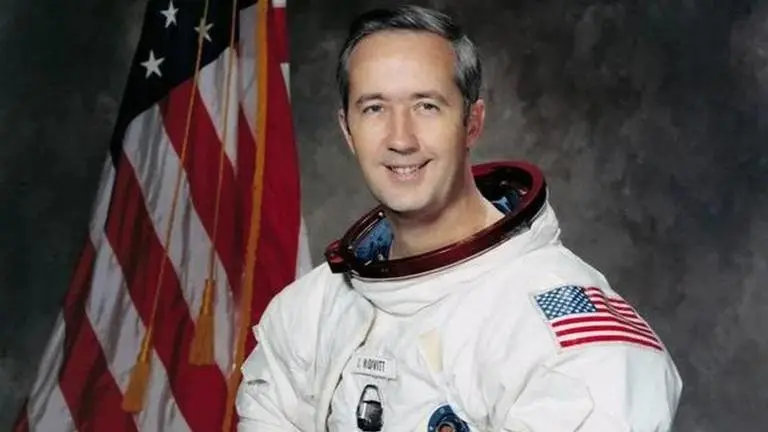
Astronaut James A. McDivitt, nicknamed Jim McDivitt who commanded the Apollo 9 mission in 1969, died at the age of 93, NASA confirmed on October 18. According to the agency, McDivitt passed away in his sleep while being surrounded by his friends and family in Tuscon, Arizona. A veteran of the Korean War, McDivitt had an illustrious career that won him multiple accolades during his lifetime.
With heavy hearts, we mourn the recent passing of Korean War veteran, former test pilot, aeronautical engineer, and @NASA astronaut Jim McDivitt. McDivitt was selected to be part of Astronaut Group 2 and went on to command Gemini IV in 1965 and Apollo 9 in 1969. Rest in peace 🫡 pic.twitter.com/PRvTShrnwy
— NASA History Office (@NASAhistory) October 17, 2022
About James McDivitt
Born on June 10, 1929, McDivitt graduated from Michigan’s Kalamazoo Central High School before going on to receive a Bachelor of Science degree in Aeronautical Engineering from the University of Michigan as the top student in his class. In 1951, he joined the US Air Force and logged more than 5,000 flying hours during his piloting career which involved 145 combat missions during the Korean War in the F-80 and F-86 aircraft.
For his military service, he was awarded two Air Force Distinguished Service Medals, four Distinguished Flying Crosses, five Air Medals, and U.S. Air Force Astronaut Wings along with the Chong Moo Medal from South Korea, the U.S. Air Force Systems Command Aerospace Primus Award, the Arnold Air Society JFK Trophy, the Sword of Loyola, and the Michigan Wolverine Frontiersman Award.
Career at NASA
McDivitt's career at NASA began in September 1962 when he became part of the agency's second astronaut class. He was soon selected as the commander of the Gemini IV mission in June 1965 and he flew with his fellow Air Force pilot Ed White. Gemini IV is remembered as one of the most ambitious flights as it saw White venture outside his spacecraft for what officially is known as extravehicular activity (EVA) or spacewalk.
Advertisement
McDivitt's expertise was used for missions of the Apollo Program as well. He was selected as the commander of Apollo 9 which launched from NASA’s Kennedy Space Center on March 3, 1969. Also including Command Module Pilot David Scott and Lunar Module Pilot Russell Schweickart, the mission involved performing an engineering test of the first crewed lunar module and carrying out maneuvers that would be performed during actual lunar missions. After Apollo 9, he was appointed as the manager of lunar landing operations and went on to guide the program through Apollo 12, 13, 14, 15 and 16 missions.