
NASA astronauts achieve new milestone by recovering water from urine in Space
NASA announced that it successfully recovered 98% of clean water by processing the urine of astronauts aboard the International Space Station.
- Science News
- 3 min read

;'%3e%3cpath%20d='m8,15.99c4.41,0,7.99-3.58,7.99-7.99S12.41,0,8,0,0,3.59,0,8s3.58,7.99,7.99,7.99Z'%20style='stroke:%23fff;%20stroke-miterlimit:10;%20stroke-width:.02px;'/%3e%3cpath%20d='m3.08,3.37l3.82,5.11-3.84,4.15h.87l3.37-3.64,2.72,3.64h2.94l-4.04-5.39,3.58-3.87h-.86l-3.1,3.35-2.5-3.35h-2.94Zm1.27.64h1.35l5.97,7.99h-1.35l-5.97-7.99Z'%20style='fill:%23fff;'/%3e%3c/g%3e%3c/svg%3e)


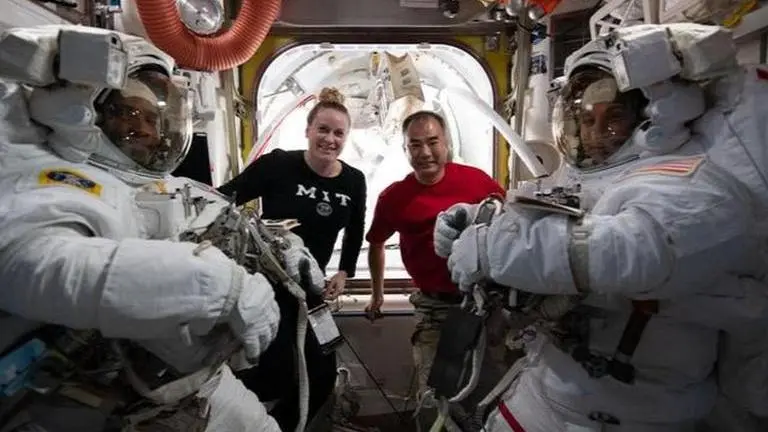
NASA has achieved a new milestone in its attempt to ensure water security in space. The agency announced last week that it achieved its goal of 98% water recovery from the urine of astronauts. This was made possible using the sub-systems that are part of the Environment Control and Life Support Systems (ECLSS) aimed at regenerating or recycling consumables such as food, air and water for further use in space.
NASA achieves water recovery milestone
The clean water was extracted from urine using vacuum distillation of the Urine Processor Assembly (UPA). NASA says that the distillation produces water and a urine brine that still contains some reclaimable water; something which led to the development of the Brine Processing Assembly (BPA). Christopher Brown, part of the team at Johnson Space Center, said that the BPA increased the amount of clean water extracted from urine from 94% to 98%, the highest so far.

(Astronaut Matthias Maurer changes out the bladder in the space station’s Brine Processor Assembly; Image: NASA)
“The processing is fundamentally similar to some terrestrial water distribution systems, just done in microgravity,” Jill Williamson, ECLSS water subsystems manager said in an official statement. “The crew is not drinking urine; they are drinking water that has been reclaimed, filtered, and cleaned such that it is cleaner than what we drink here on Earth." This confidence of the experts has brought them closer to ensuring water security when astronauts launch to space for long-term missions to the Moon and Mars.
Advertisement
The scientists explained that BPA produces clean water by collecting the urine brine and running it through a special membrane (shown in the picture above with astronaut Matthias). The next step is exposing the brine to warm and dry air to evaporate the water content. This evaporation creates humid air which is collected by the water collection systems on the space station. The process doesn't end here as the water goes into the Water Processor Assembly (WPA) for treatment and iodine is added to it to prevent the growth of microbes. We have a lot of processes in place and a lot of ground testing to provide confidence that we are producing clean, potable water," Williamson said.
Astronauts in space need as much as one gallon of water per day for consumption, food preparation and hygiene and the need for recycled water increases as humanity continues to expand beyond the low-Earth orbit. NASA already has plans to establish bases on the Moon where this technology could be a game-changer by eliminating the need to carry a limited amount of water from Earth.