
NASA is preparing for deep space explorations with 5 ISS experiments; here're the details
The astronauts currently living aboard the revolving observatory have shared some more of their experiments, wherein they tested various technologies.
- Science News
- 3 min read

;'%3e%3cpath%20d='m8,15.99c4.41,0,7.99-3.58,7.99-7.99S12.41,0,8,0,0,3.59,0,8s3.58,7.99,7.99,7.99Z'%20style='stroke:%23fff;%20stroke-miterlimit:10;%20stroke-width:.02px;'/%3e%3cpath%20d='m3.08,3.37l3.82,5.11-3.84,4.15h.87l3.37-3.64,2.72,3.64h2.94l-4.04-5.39,3.58-3.87h-.86l-3.1,3.35-2.5-3.35h-2.94Zm1.27.64h1.35l5.97,7.99h-1.35l-5.97-7.99Z'%20style='fill:%23fff;'/%3e%3c/g%3e%3c/svg%3e)


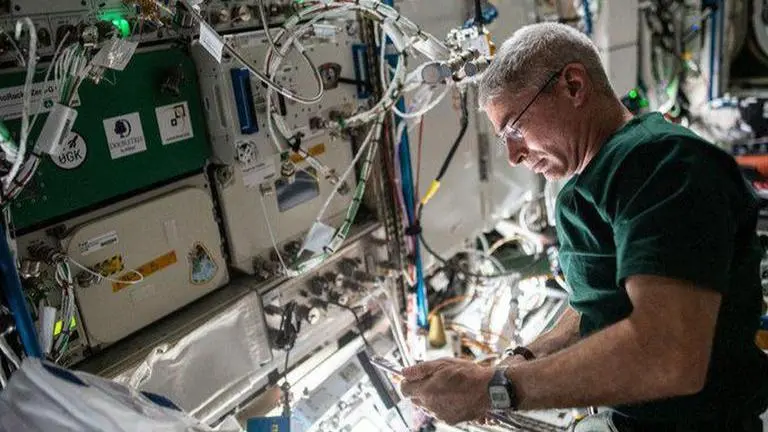
The International Space Station (ISS) has been an epicenter of experiments that are preparing humans to eventually expand their reach beyond the Earth. In its 21 years of existence, the ISS has supported over 3,000 experiments which have been shared in numerous publications over the years.
The astronauts currently living aboard the revolving observatory have shared some more of their experiments, wherein they tested technologies regarding life support systems and construction of Moon bases among others. Here are five of many important experiments that are contributing to NASA's attempt for deep space missions.
Over the past few months, scientists have shared the outcomes of @Space_Station studies that could help us construct Moon bases, better recycle water, grow plants in space, and more.
— ISS Research (@ISS_Research) January 21, 2022
Explore the results: https://t.co/ssTKaipExY
The Brine Processor Assembly
This experiment was basically to demonstrate the technology that could filter the leftover waste resulting from the Urine Processor Assembly (UPA), a part of the environmental control and life support system (ECLSS) on ISS. With UPA, the ISS astronauts are able to recover 94% of wastewater for their usage after their urine is processed. So this experiment is to test technology to purify the remaining 4% of the wastewater.
According to NASA, astronauts on future deep-space missions will need a self-contained water system through which they would recover, recycle, and reuse more than 98% of the water. After several rounds of testing, NASA said that the BPA is functioning as intended and will soon return to Earth for efficiency confirmation.
Advertisement
Manufacturing cement for lunar bases
Since scientists now know that cement mixed on Earth behaves differently than cement mixed in space, astronauts have manufactured a new cement type using Lunar regolith simulant (JSC-1A), a mock lunar soil. Known as the Microgravity Investigation of Cement Solidification (MICS), this experiment, according to NASA, would be used to make bases on the Moon.
This mock lunar soil has been used to create metals, glasses, and cement on Earth and the experiment revealed that mixing it with cement and water yields mortar. NASA believes that the experiments have proven lunar dust to be the perfect material to build bases on the Moon.
Advertisement
Fast data transfer in space
With the Small Optical Communication System (SOLISS), scientists are trying to develop communication methods to transfer large amounts of data from space to Earth in a short time.
The SOLISS is a small Japan Aerospace Exploration Agency (JAXA) communication terminal that is attached to the ISS and runs on laser technology.
The new plant growth method
ISS astronauts are also testing the Passive Orbital Nutrient Delivery System (PONDS) plant growth method which involves providing plants with water and nutrients in space without electricity. According to NASA, astronauts on deep space missions can use this technology to produce fresh vegetables for a nutritional diet.
Effects of outer space on fertility
With the Space Pup experiment, NASA is studying how the space environment affects mammalian fertility. Under this experiment, mouse sperm samples were sent to the ISS and returned after varying time periods- nine months, then two years and nine months, and finally after 5 years and 10 months.
The results revealed that space radiation caused no effect on the sperm DNA or fertility and yielded normal offspring on Earth with the same success rate.