
NASA makes new discovery about asteroid-aging, thanks to its OSIRIS-REx spacecraft
NASA revealed that the Bennu asteroid underwent surface regeneration much earlier than previously thought, a discovery made using OSIRIS-REx images.
- Science News
- 2 min read

;'%3e%3cpath%20d='m8,15.99c4.41,0,7.99-3.58,7.99-7.99S12.41,0,8,0,0,3.59,0,8s3.58,7.99,7.99,7.99Z'%20style='stroke:%23fff;%20stroke-miterlimit:10;%20stroke-width:.02px;'/%3e%3cpath%20d='m3.08,3.37l3.82,5.11-3.84,4.15h.87l3.37-3.64,2.72,3.64h2.94l-4.04-5.39,3.58-3.87h-.86l-3.1,3.35-2.5-3.35h-2.94Zm1.27.64h1.35l5.97,7.99h-1.35l-5.97-7.99Z'%20style='fill:%23fff;'/%3e%3c/g%3e%3c/svg%3e)


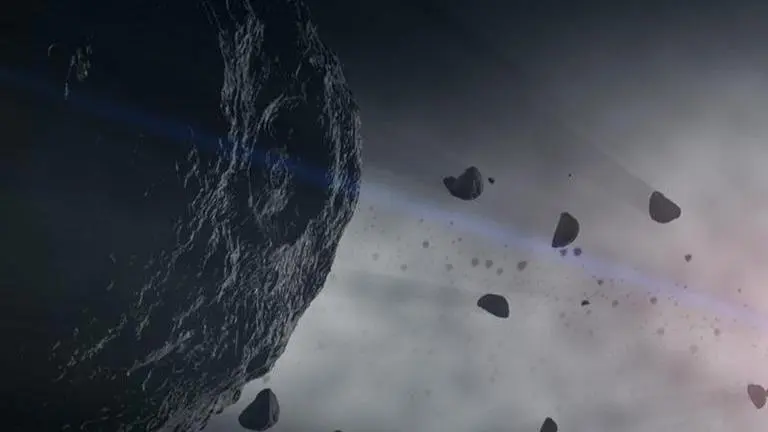
NASA scientists have made a new discovery about the surface regeneration of asteroids, in other words, the aging of space rocks. This discovery was possible thanks to the images of the Bennu asteroid sent by NASA's OSIRIS-REx spacecraft. The spacecraft collected samples of the asteroid after landing in 2020 and is currently on its way to delivering those samples next year.
Don't forget to wear sunscreen.
— NASA (@NASA) July 24, 2022
Some asteroids are aged early by the Sun, with surface rocks fracturing in just 10,000-100,000 years. Analysis of images from our #OSIRISREx mission revealed a weathering process that happens fast, geologically speaking: https://t.co/EupmNjFsKe pic.twitter.com/gFfkIhQXgV
"We thought surface regeneration on asteroids took a few millions of years", Marco Delbo, senior scientist at Université Côte d'Azur, and lead author of a paper published in Nature Geoscience said in a statement. "We were surprised to learn that the aging and weathering process on asteroids happens so quickly, geologically speaking".
After analysing the pictures of Bennu, the scientists found that the Sun’s heat fractured the rocks on the asteroid in just 10,000 to 1,00,000 years, which is much earlier than expected. Measuring about 450 metres wide, the asteroid is located around 168 million kilometers from the sun and witnesses a sunrise every 4.3 hours. The temperature at its equator reaches 127°C during the daytime and drops to -23°C during the night. The scientists say that these wild temperature fluctuations create internal stress that fractures and breaks down rocks, similar to a cold glass breaking under hot water.
Following the analysis of the cracks seen in the pictures, the scientists concluded that "temperature shocks between the day and the night could be the cause". According to the experts, this information would help them estimate how long it takes boulders on asteroids like Bennu to break down into smaller particles, which may either eject into space or stay on the asteroid’s surface.
Advertisement
OSIRIS-REx makes a narrow escape
Earlier this month, NASA revealed that the OSIRIS-REx spacecraft made a narrow escape after it managed to avoid sinking into Bennu's loose surface. The mission team used the spacecraft's thrusters to keep it afloat as the asteroid's exterior is extremely loosely bound and offers very little resistance. Launched in September 2016, the OSIRIS-REx spacecraft will deliver the collected samples in 2023 and head toward the Apophis asteroid in an extended mission.
A ball pit for spacecraft??
— NASA (@NASA) July 7, 2022
Upon studying data from OSIRIS-REx, scientists discovered the surface of asteroid Bennu is loosely bound and offers very little resistance. In fact, the spacecraft had to use its thrusters to avoid sinking in: https://t.co/FzaEtZDz3t pic.twitter.com/tpYpfzUGPp