
NASA puts students to mine simulated lunar surface; collects ideas for Moon & Mars mission
NASA's LUNABOTICS 2022 challenge saw university students bring over 30 one-of-a-kind robots to test technologies for carrying out excavations on the Moon.
- Science News
- 2 min read

;'%3e%3cpath%20d='m8,15.99c4.41,0,7.99-3.58,7.99-7.99S12.41,0,8,0,0,3.59,0,8s3.58,7.99,7.99,7.99Z'%20style='stroke:%23fff;%20stroke-miterlimit:10;%20stroke-width:.02px;'/%3e%3cpath%20d='m3.08,3.37l3.82,5.11-3.84,4.15h.87l3.37-3.64,2.72,3.64h2.94l-4.04-5.39,3.58-3.87h-.86l-3.1,3.35-2.5-3.35h-2.94Zm1.27.64h1.35l5.97,7.99h-1.35l-5.97-7.99Z'%20style='fill:%23fff;'/%3e%3c/g%3e%3c/svg%3e)


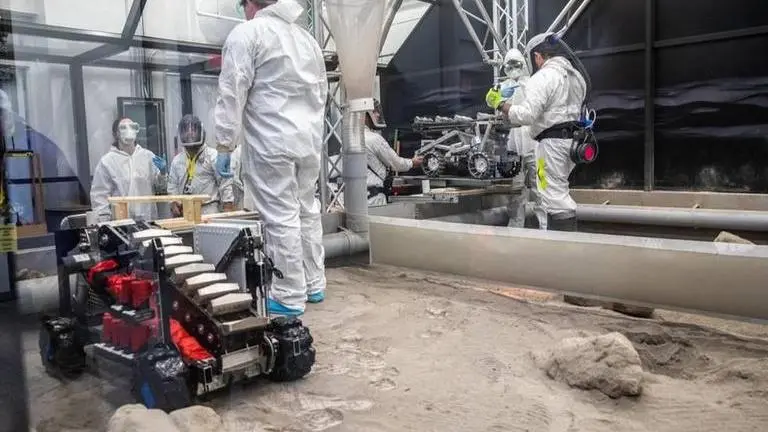
NASA recently organised a competition that saw students from different universities across the USA bring over 30 one-of-a-kind robots to mine a simulated lunar surface. The competition, which ended last month, challenged the students to dig deep into the lunar regolith and collect as many rocks as they could and deposit them in a collection bin. NASA said that the ideas brought forward by the students during the LUNABOTICS 2022 challenge could be used during robotic explorations on the Moon and eventually on Mars.
A challenge where your ideas could be used on @NASAArtemis missions to the Moon or Mars? Game on.
— NASA Internships (@NASAInterns) June 30, 2022
Check out the latest student NASA LUNABOTICS competition at @NASAKennedy: https://t.co/kxgz1wCO2s. pic.twitter.com/9xOhO5ulPD
NASA inaugurates new mining area to prepare for deep space missions
The competition, which was the first in-person competition in three years, also saw former NASA astronaut Bruce Melnick inaugurate the new mining facility for the students, which would also be used to test lunar excavation technologies. "Just like the Apollo missions sparked a fire of curiosity and perseverance in the hearts of students so many years ago, Artemis is challenging this generation to dream bigger, think differently, innovate more critically, and be inspired like never before", Janet Petro, Director of NASA's Kennedy Space Center said in a statement.

(Candidates with their rover; Image: NASA)
Artemis is NASA's new programme aimed at taking humans back to the Moon and landing the first woman and the person of colour on the lunar surface. The agency revealed that during this year's challenge, many teams faced trouble with their rovers as they got stuck in the regolith or on obstacles placed in the mining arena and some just refused to move.
Advertisement

(Image: NASA)
Robert Mueller, the principal investigator in Kennedy’s Exploration Systems and Development Office, revealed that the regolith stimulant used in the mining area this year was much similar to the actual lunar surface. "An interesting effect was that the regolith simulant was drier than when it was outdoors in a tent, so the competitors noticed a change in its shear strength, causing it to fluff up, making it harder to drive on", Mueller said.
Advertisement
Currently, NASA and its international partners in Europe are working on multiple designs of rovers that they intend to use for sampling purposes on the Moon and Mars. Last month, NASA announced that its lunar rover VIPER underwent 'the most realistic' practice of its lunar exploration, whereas, the German Space Agency just completed testing a range of different robots at Italy's Mount Etna volcano, which has some shared characteristics with the lunar surface.