
NASA releases new James Webb Space Telescope image featuring Jupiter in amazing detail
NASA released new images of the gas giant Jupiter which have been captured by the James Webb Space Telescope's Near-Infrared Camera (NIRCam).
- Science News
- 2 min read

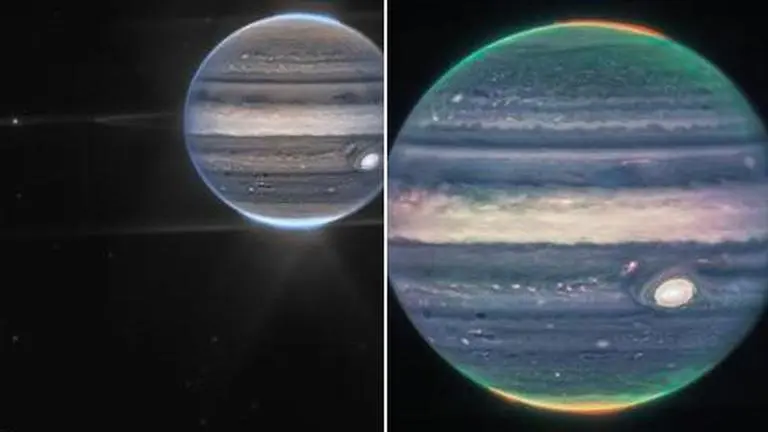
Jupiter, the king of our solar system, has emerged like never before, thanks to the James Webb Space Telescope. The world's most powerful observatory recently photographed the gas giant using its Near-Infrared Camera (NIRCam) instrument. Webb has a suite of four instruments; the other three are-- the Near-Infrared Spectrograph (NIRSpec), the Mid-Infrared Instrument (MIRI), and the Fine Guidance Sensor/Near InfraRed Imager and Slitless Spectrograph (FGS/NIRISS).
1. Make way for the king of the solar system! 👑
— NASA Webb Telescope (@NASAWebb) August 22, 2022
New Webb images of Jupiter highlight the planet's features, including its turbulent Great Red Spot (shown in white here), in amazing detail. These images were processed by citizen scientist Judy Schmidt: https://t.co/gwxZOitCE3 pic.twitter.com/saz0u61kJG

(Image: NASA/ESA/CSA/STScI)
The picture above is a composite of images captured using three specialised infrared filters of NIRCam. Infrared is the wavelength of light which is invisible but can be felt as heat. According to NASA, the light emerging from Jupiter was mapped onto the visible spectrum and the colours red and blue represent longer and shorter wavelengths of light, respectively. As you can see, the auroras on Jupiter's poles appear red through one filter.
The same filter also mapped the lower clouds and upper hazes in red whereas the hazes swirling around the two poles are represented in yellow and green in a second filter. In addition to this, the colour blue of Jupiter showcases light that is reflected from a deeper main cloud through the third filter.
Advertisement

(Image: NASA/ESA/CSA/STScI)
The second image above is a wide-field view of the gas giant which features the Moon's Amalthea and Adrastea. Interestingly, Webb also managed to photograph the rings along with faint galaxies photobombing the planet in the background. NASA says that the Great Red Spot, which is a storm big enough to swallow the entire Earth, appears white in this image because of the amount of sunlight it is reflecting.
Advertisement
"The brightness here indicates high altitude – so the Great Red Spot has high-altitude hazes, as does the equatorial region,” Heidi Hammel, Webb interdisciplinary scientist for solar system observations said in an official statement. "The numerous bright white ‘spots’ and ‘streaks’ are likely very high-altitude cloud tops of condensed convective storms".
Planetary scientist Imke de Pater from the University of California, Berkeley, said that the astronomers had not expected these images to be this detailed. "It’s really remarkable that we can see details on Jupiter together with its rings, tiny satellites, and even galaxies in one image", he said.