
Updated 4 September 2023 at 00:08 IST
NASA revisits iconic Cassini image of Saturn with tiny Earth lurking in the dark
NASA launched Cassini in 1997 to Saturn and the orbiter arrived at the ringed planet in 2004. The mission ended when Cassini plunged into Saturn in 2017.
- Science News
- 2 min read

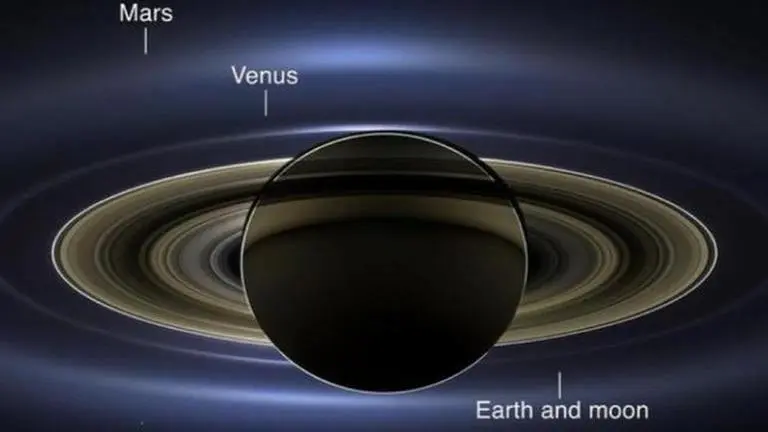
NASA has shared an awe-inspiring image of Saturn as seen from the revered Cassini spacecraft which uncovered the ringed planet for us. Launched in 1997 from the Cape Canaveral Air Force Station, Cassini arrived at Saturn in 2004 and made dozens of flybys of the planet and its icy Moons.
Taking to Instagram, NASA posted a serene picture of the sixth planet of our solar system with Mars, Venus, Earth and the moon photobombing from a staggering distance.
According to NASA, the picture was taken from a distance of 1.2 million kilometres from Earth and it was created using red, green and blue filters for a natural look. The photo comes at a time when Saturn will grace the sky at sunset each day until February 2024. The planet will be visible like a bright yellowish star on the southeastern horizon, NASA said.
In the picture, Saturn appears silhouetted with bright sunlight with small blue, white and yellow coloured dots representing the moons and the planets.
Advertisement
Cassini's legacy
The Cassini spacecraft is remembered for unravelling many secrets of Saturn and its moons. This mission was also the first to land on an alien world in the outer solar system when the European Huygens probe released from Cassini touched down on Saturn's Moon Titan.

(NASA's Cassini spacecraft; Image: NASA)
Advertisement
The Cassini orbiter also observed moons where methane rivers flow into a methane sea and jets of ice and gas get sprayed out into outer space from an ocean-harbouring world. NASA says that the spacecraft's mission was extended twice - first for two years and again for seven years - and it ended in 2017 when Cassini plunged into the Saturn after exhausting its fuel supply. In more than a decade-long observations, Cassini gave scientists an idea about the kind of worlds where life might exist, it enabled them to monitor weather and seasonal changes on another planet and expanded their understanding of the outer solar system.
It is worth noting, however, that Cassini was not the first spacecraft to study Saturn upclose as NASA's Pioneer 11 probe studied the planet 44 years ago.
Published By : Harsh Vardhan
Published On: 4 September 2023 at 00:08 IST