
NASA scientist develops motorless sailplanes to explore Mars for days at a time
NASA engineer Alexandre Kling, in collaboration with the University of Arizona, has developed a wind-powered sailplane that can fly on Mars for days at a time.
- Science News
- 3 min read

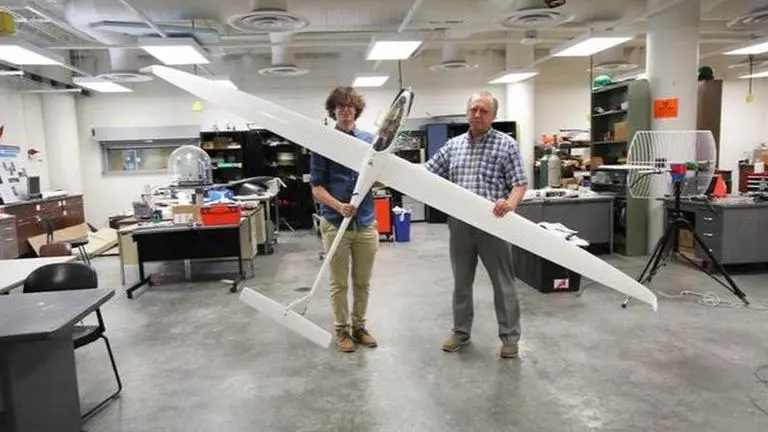
A NASA engineer, in partnership with the University of Arizona, has developed a motorless airplane that can fly on Mars for days at a time. Called 'sailplanes', this new device will use only the wind for propulsion and would help in a detailed study of the Martian atmosphere. According to Alexandre Kling, a research scientist at NASA's Mars Climate Modeling Center, the plane weighs roughly 2kg and has a wingspan of about 11 feet.
A concept developed by University of Arizona aerospace experts and a @NASA planetary scientist takes inspiration from albatross flight to learn more about the atmosphere and geology of Mars. https://t.co/5iJJgbZ42r pic.twitter.com/EtimXNRSby
— University of Arizona (@uarizona) June 30, 2022
The idea behind the plane
While rovers and orbiters are of great help in gathering imagery and first-hand data, there is an essential component of the red planet that interests most planetary scientists. The idea behind developing this plane is to examine a planetary boundary layer just a few kilometers above the surface. "This is where all the exchanges between the surface and atmosphere happen," Kling said in a statement. "This is where the dust is picked up and sent into the atmosphere, where trace gases are mixed, where the modulation of large-scale winds by mountain-valley flows happen. And we just don't have very much data about it."

(Prototype of a sailplane: Image: Emily Dieckman/College of Engineering/University of Arizona)
Another reason why this sailplane would prove to be extremely helpful in Mars exploration is its significantly longer operational time. The Ingenuity helicopter, which was sent to Mars with the Perseverance rover last year, can fly for only three minutes at a time using solar power, and it reaches heights of just 12 meters (39 feet). The sailplanes, on the other hand, would fly in the Martian skies for days, enabling them to reach farther than Ingenuity and visit new locations.
Advertisement
Functioning of the sailplanes
These sailplanes which use only wind for propulsion are equipped with flight, temperature and gas sensors as well as cameras. In a paper published in the journal Aerospace, the team details several methods through which it plans to launch the planes on Mars, keep them afloat and make them land. The engineers are planning to send the planes as a secondary payload on a larger Mars mission.
For deployment, the team proposes packaging the planes in CubeSats and once these CubeSats are deployed, the planes would unfold like origami or inflate to their full size. Another method is deploying the planes with balloons that would slow the sailplanes' descent and allow them to take off during optimal wind conditions. The same balloons could also be used to dock the planes making them capable of taking off again for multiple flights.
Advertisement

(Sailplane during a test launch with a balloon; Image: Emily Dieckman/College of Engineering/University of Arizona)
While the concept is yet to be adopted by NASA, the sailplane developers are preparing to test the planes at 15,000 feet above sea level, where Earth's atmosphere is thinner and flight conditions are more akin to those on Mars. "We can use the Earth as a laboratory for studying flight on Mars," Sergey Shkarayev, University of Arizona professor and the paper's first author said.