
NASA spacecraft enters Sun's atmosphere: WATCH 1st visuals shared from Parker Solar Probe
NASA's spacecraft Parker Solar Probe, which was launched in 2018 flew past the Sun's outer atmosphere and entered its Corona, the outer atmosphere
- Science News
- 4 min read

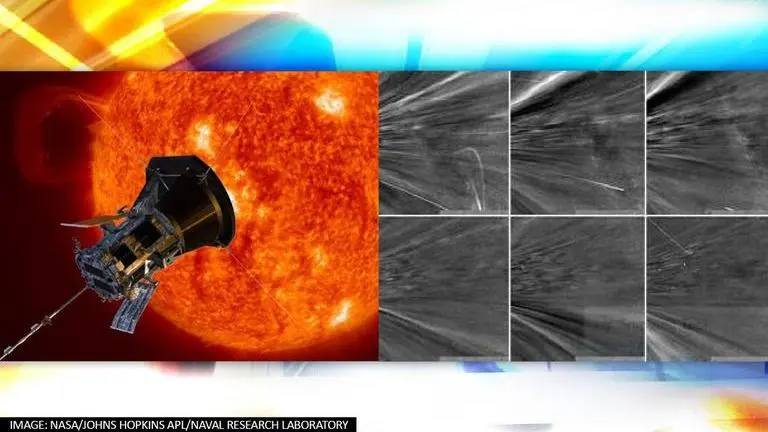
In a historic first, NASA's spacecraft Parker Solar Probe touched the Sun flying past its outer atmosphere and entering the 'Corona', the Sun's upper atmosphere on December 15. The American space agency stated that the spacecraft has sampled particles and magnetic fields in Corona which is 'one giant leap for solar science'.
"The new milestone marks one major step for Parker Solar Probe and one giant leap for solar science. Just as landing on the Moon allowed scientists to understand how it was formed, touching the very stuff the Sun is made of will help scientists uncover critical information about our closest star and its influence on the solar system," NASA's press statement read.
A day after getting as close as 13 million kilometres to the Sun, NASA released a series of visuals of the Parker Solar Probe venturing through the Sun's Corona at approximately more than 1 million-degree solar plasma.
Watch the Parker Solar Probe entering the Sun's atmosphere -
Advertisement
NEWS 🚨: NASA releases footage of Parker Solar Probe flying through the sun’s corona and 1 million+ degree solar plasma 🥵pic.twitter.com/HcxpEzxN8X
— Latest in space (@latestinspace) December 15, 2021
NASA's Parker Solar Probe attains historic milestone
The Associate Director of Science Mission Directorate at NASA Headquarters in Washington said, "Not only does this milestone provide us with deeper insights into our Sun's evolution and its impacts on our solar system, but everything we learn about our own star also teaches us more about stars in the rest of the universe.”
Another scientist said, "Flying so close to the Sun, Parker Solar Probe now senses conditions in the magnetically dominated layer of the solar atmosphere – the corona – that we never could before. We can actually see the spacecraft flying through coronal structures that can be observed during a total solar eclipse.”
Advertisement
What is NASA's Parker Solar Probe?
To explore the mysteries of the Sun by travelling closer to it than 'ever before', Parker Solar Probe was launched by NASA in 2018 only to have arrived three years since the launch. The objective of the Probe was to record repetitive and close passes around the Sun. The same is possible by keeping the effects of the Sun's heat at bay by moving at a ferocious speed f 500,000 kmph to enable smooth movement.
"For the first time, the spacecraft found itself in a region where the magnetic fields were strong enough to dominate the movement of particles there. These conditions were the definitive proof the spacecraft had passed the Alfvén critical surface (where gravity and magnetic fields are too weak to contain heat and pressure) and entered the solar atmosphere where magnetic fields shape the movement of everything in the region," NASA detailed.
NASA has released official visuals of the Parker Solar Probe spacecraft; the video is captioned - "For the first time in history, a spacecraft has touched the Sun. NASA’s Parker Solar Probe has now flown through the Sun’s upper atmosphere – the corona – and sampled particles and magnetic fields there."
The video at approximately 3 minutes shows how the probe flies through the Corona of the Sun. As the spacecraft passes through, there can be bright screen-like features seen which are known as 'Coronal Streamers'. NASA also explained that these streamers have only been seen from the Earth during Solar Eclipses.
NASA on its official website wrote, "As Parker Solar Probe passed through the corona on encounter nine, the spacecraft flew by structures called coronal streamers. These structures can be seen as bright features moving upward in the upper images and angled downward in the lower row. Such a view is only possible because the spacecraft flew above and below the streamers inside the corona. Until now, streamers have only been seen from afar. They are visible from Earth during total solar eclipses."

Why didn't the Parker Solar Probe burn?
According to NASA, the probe is equipped with a heat shield that is capable to protect the spacecraft from temperatures even greater than what it is facing currently. Measuring 4.5-inch-thick the carbon-composite heat shield is capable of enduring temperatures up to 1,377 degrees celsius, a number which Parker would face at its closest approach to the Sun.