
NASA surprised over Bennu's surface after its spacecraft escaped sinking in the asteroid
NASA's OSIRIS-REx spacecraft scooped up samples from the Bennu asteroid in 2020 and is now on its way to Earth, a journey that will end in 2023.
- Science News
- 2 min read

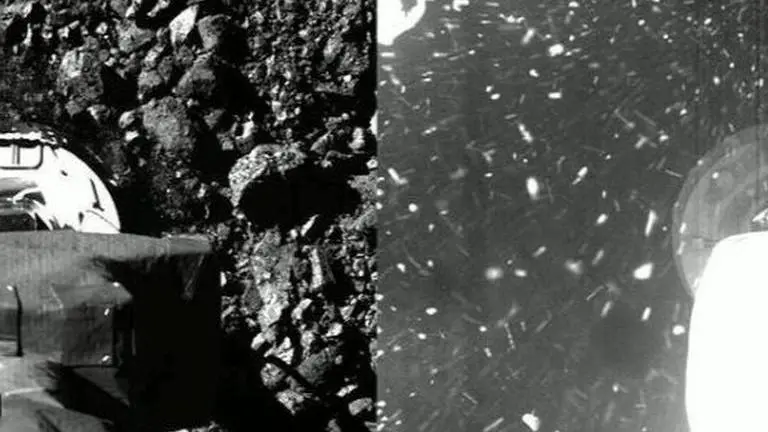
NASA revealed that its scrutiny of the Bennu asteroid has unearthed an astonishing discovery about its surface. In a recently released report, the agency revealed that its OSIRIS-REx spacecraft, which scooped up samples of Bennu in 2020, narrowly escaped a risk due to the loosely packed exterior of the asteroid. According to NASA, the spacecraft would have sunk inside the asteroid had it not fired its thrusters to back away after sample collection.
A ball pit for spacecraft??
— NASA (@NASA) July 7, 2022
Upon studying data from OSIRIS-REx, scientists discovered the surface of asteroid Bennu is loosely bound and offers very little resistance. In fact, the spacecraft had to use its thrusters to avoid sinking in: https://t.co/FzaEtZDz3t pic.twitter.com/tpYpfzUGPp
“If Bennu was completely packed, that would imply nearly solid rock, but we found a lot of void space in the surface”, said Kevin Walsh, a member of the OSIRIS-REx science team from Southwest Research Institute. The scientists also concluded that if any human would step on the asteroid, they would experience little resistance similar to stepping on a pit of plastic balls.
However, this is not the first time the Bennu asteroid has astonished NASA scientists. Their first experience was in December 2018 when the agency’s spacecraft reached Bennu and touched down on its surface. The experts found that Bennu’s surface is littered with boulders, contrary to the expectations of the space rock having a smooth and sandy surface suggested by the observations with space and ground-based telescopes.
Bennu is spitting particles of rocks in space
Scientists involved in the study of Bennu have discovered that the asteroid is spitting rocks on its surface into outer space. “Our expectations about the asteroid’s surface were completely wrong”, Dante Lauretta, principal investigator of OSIRIS-REx, said in a statement. “What we saw was a huge wall of debris radiating out from the sample site”.
Advertisement
What’s more is that the spacecraft, after leaving for Earth, carved a 26 feet (8 meters) wide crater on Bennu’s surface. Interestingly, the mission team sent OSIRIS-REx back to Bennu for a few more pictures of the carved crater “to see how big of a mess we made”, Lauretta said. Launched on September 8, 2016, the spacecraft is currently on its way to Earth with the Bennu asteroid samples. After its arrival next year, the spacecraft will be redirected to Apophis, a near-Earth asteroid, under an extended mission.