
NASA to launch LAMP rocket mission to determine what causes aurora formation
NASA's LAMP mission would see the launch of a sounding rocket into the pulsating auroras, which would take measurements before falling back to Earth.
- Science News
- 2 min read

;'%3e%3cpath%20d='m8,15.99c4.41,0,7.99-3.58,7.99-7.99S12.41,0,8,0,0,3.59,0,8s3.58,7.99,7.99,7.99Z'%20style='stroke:%23fff;%20stroke-miterlimit:10;%20stroke-width:.02px;'/%3e%3cpath%20d='m3.08,3.37l3.82,5.11-3.84,4.15h.87l3.37-3.64,2.72,3.64h2.94l-4.04-5.39,3.58-3.87h-.86l-3.1,3.35-2.5-3.35h-2.94Zm1.27.64h1.35l5.97,7.99h-1.35l-5.97-7.99Z'%20style='fill:%23fff;'/%3e%3c/g%3e%3c/svg%3e)


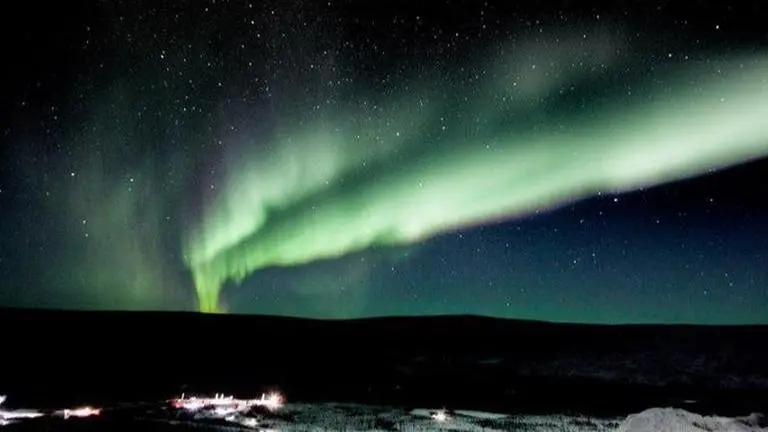
The aurora borealis or northern lights is a phenomenon that is nothing short of a treat for those living around the northern latitudes. While the auroras have been spotted dancing in the northern skies, there still are some theories that scientists want to test to find out what causes them. In a bid to do so, NASA is launching a new mission on February 24 named LAMP over the skies of Alaska to determine the science behind their formation.
“It’s sort of hypnotic – kind of like a lava lamp”
— NASA Sun & Space (@NASASun) February 23, 2022
Pulsating aurora are a special kind of northern and southern lights that brighten and then dim every few seconds. NASA is launching a rocket from Alaska in hopes of figuring out what causes them. 🚀
More: https://t.co/58v3qu3vhV pic.twitter.com/HO9GkgNFbb
NASA’s new LAMP mission
Short for Loss through Auroral Microburst Pulsation, the LAMP mission would see NASA launch a sounding rocket into the pulsating auroras, which would take measurements before falling back to Earth. NASA said that the rocket will be launched once the ground-based cameras at the Poker Flat Research Range spot the auroras pulsate.
Explaining the science of pulsating auroras, NASA said that they are, like all auroras, set alight by electrons (and occasionally protons) from near-Earth space. It further explained that when these electrons plunge into our atmosphere and collide with atoms and molecules, they release their excess energy which causes them to glow in different colours. The red and green colours are caused by oxygen whereas the blue colour is a result of nitrogen. It is worth noting that the pulsating auroras are a type of the northern lights that NASA is targeting.
During the mission, the rocket, while flying through the pulsating aurora, would measure the low-energy particles that cause them as well as the medium- and high-energy electrons that should also come from a chorus wave. The chorus waves are basically plasma waves and have been named so because they were first detected as audio signals in radio receivers during World War I, as per NASA. On the ground, the rocket team would confirm its measurements using independent measurements of high-energy electrons, which would be provided by a device called a riometer.
Advertisement
“We have all but one piece of the puzzle that we’re hoping to catch simultaneously…but any of it is going to provide us new information and hopefully help us test that theory that it’s the chorus waves behind it all,” Halford said as per NASA.