
Updated 13 January 2024 at 15:38 IST
First Visuals: X-59 Quesst Supersonic Plane That Can Break Sound Barrier Unveiled by NASA
For the last 50 years, commercial supersonic travel over land has been banned in the US because of public concerns over the explosive sonic booms
- Science News
- 3 min read

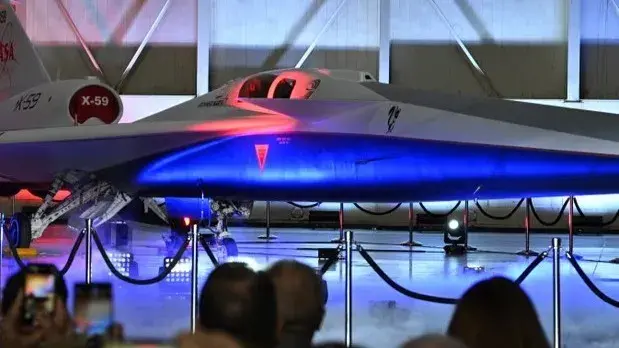
Palmdale, California: NASA on Friday in Palmdale, California, unveiled its newest X-plane design. The X-59 is designed to break the sound barrier without the sonic booms accompanying a supersonic aircraft.
“Together with @LockheedMartin, we've unveiled our new X-59 supersonic plane. The X-59 will fly later this year on the #Quesst mission to test quieter sonic booms. What we learn could reopen the skies to commercial supersonic air travel,” NASA posted on X.
“Introducing the X-59, our experimental supersonic aircraft that aims to make sonic booms quieter, and help lift the ban on commercial supersonic flight. Your ears – and pets – will love it. Follow @NASAAero for #Quesst mission updates,” NASA further said.
Here Are Images of the X-59 Supersonic Plane

Top Features of the X-59 Supersonic Plane
- NASA revealed the X-59, an experimental aircraft that is expected to fly at 1.4 times the speed of sound (1,488 km/h).
- X-59 Quesst Supersonic Plane unveiled by NASA is being hailed by experts as "collaborative genius”.
- NASA's newest X-plane, the X-59 is a supersonic jet plane that can break the sound barrier without the thunderous sonic booms that typically occur when aircraft go supersonic.
- The aircraft, which stands at 99.7ft (30.4 metres) long and 29.5ft wide, has a thin, tapered nose that comprises nearly a third of the aircraft’s full length – a feature designed to disperse shock waves that would typically surround supersonic aircraft and result in sonic booms
- In attempts to further enhance the aircraft’s supersonic capabilities, engineers positioned the cockpit almost halfway down the length and removed the forward-facing windows typically found in other aircraft
- The X-59 is set to take its first flight later this year and then its first quiet supersonic flight
- Once test flights are completed, the X-59 will fly over several cities across the US
For the last 50 years, commercial supersonic travel over land has been banned in the US because of public concerns over the explosive sonic booms that could be heard from miles away.
Advertisement
Published By : Srinwanti Das
Published On: 13 January 2024 at 14:43 IST