
NASA's Curiosity Rover captures 'shining clouds' on Mars with 'iridescent wisps'
The National Aeronautics and Space Administration’s (NASA’s) Curiosity Rover has captured the breathtaking images of “shining clouds” as seen on Mars.
- Science News
- 3 min read

;'%3e%3cpath%20d='m8,15.99c4.41,0,7.99-3.58,7.99-7.99S12.41,0,8,0,0,3.59,0,8s3.58,7.99,7.99,7.99Z'%20style='stroke:%23fff;%20stroke-miterlimit:10;%20stroke-width:.02px;'/%3e%3cpath%20d='m3.08,3.37l3.82,5.11-3.84,4.15h.87l3.37-3.64,2.72,3.64h2.94l-4.04-5.39,3.58-3.87h-.86l-3.1,3.35-2.5-3.35h-2.94Zm1.27.64h1.35l5.97,7.99h-1.35l-5.97-7.99Z'%20style='fill:%23fff;'/%3e%3c/g%3e%3c/svg%3e)


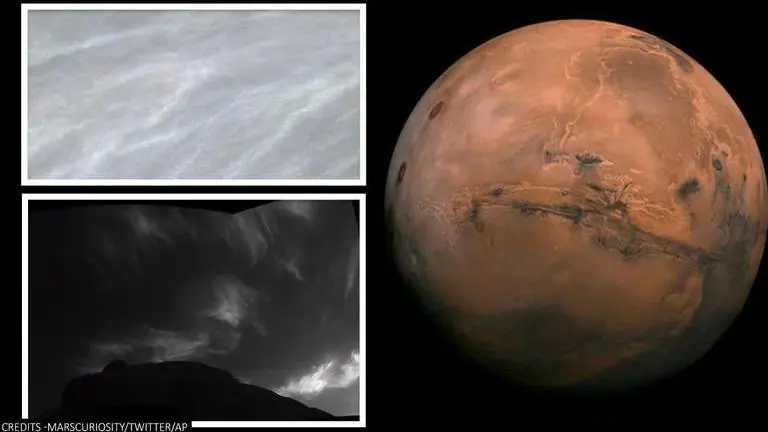
The National Aeronautics and Space Administration’s (NASA’s) Curiosity Rover has captured the breathtaking images of “shining clouds” as seen on Mars which would help the scientists to learn more about the Red Planet. Several images of the shining clouds on Mars were shared on the official Twitter account of the NASA Curiosity Rover with one of the captions saying, “Sometimes you just need to stop and watch the clouds roll by... on Mars...Cloudy days are rare here because the atmosphere is so thin and dry, but I've been keeping my cameras peeled and wanted to share some recent pictures with you.”
As per NASA’s official release on May 28, the researchers are now studying the clouds which not only arrived earlier but also formed higher than expected. The US space agency also noted that “cloudy days are rare” in the thin as well as the dry atmosphere of the Red Planet. At the coldest time of the year for the Martian planet, the clouds are formed typically at the equator of the planet, that is when the planet is farthest from the Sun in its oval-shaped orbit. But, “one full Martian year ago – two Earth years – scientists noticed clouds forming over NASA’s Curiosity rover earlier than expected.”
Hence, this year, the researchers were all braced to capture the “early” clouds from the exact moment they first appeared in late January. The documentation of the scientists “resulted are images of wispy puffs filled with ice crystals that scattered light from the setting Sun, some of them shimmering with colour. More than just spectacular displays, such images help scientists understand how clouds form on Mars and why these recent ones are different.” NASA also noted that the "iridescent wisps" are actually called "mother of pearl."
Heading into the weekend like a cloud on Mars.
— Curiosity Rover (@MarsCuriosity) May 28, 2021
This GIF shows clouds drifting over Mount Sharp. Each frame was stitched together from six individual images. https://t.co/Gtgz9Iu822 (2/4) pic.twitter.com/VPvSri1Sdh
SWEET MOTHER OF PEARL LOOK AT THESE MARTIAN CLOUDS. No, seriously. These iridescent wisps are called "mother of pearl" clouds. The shimmery pastels result when the particles in the cloud are all nearly identical in size. https://t.co/Gtgz9Iu822 (3/4) pic.twitter.com/Op73fHoTwH
— Curiosity Rover (@MarsCuriosity) May 28, 2021
SWEET MOTHER OF PEARL LOOK AT THESE MARTIAN CLOUDS. No, seriously. These iridescent wisps are called "mother of pearl" clouds. The shimmery pastels result when the particles in the cloud are all nearly identical in size. https://t.co/Gtgz9Iu822 (3/4) pic.twitter.com/Op73fHoTwH
— Curiosity Rover (@MarsCuriosity) May 28, 2021
‘Curiosity’s one new discovery’
Owing to NASA’s Mars Curiosity Rover’s work, the team has already made “one new discovery,” according to the space agency which is that the “early-arrival clouds are actually at higher altitudes than is typical. Most Martian clouds hover no more than about 37 miles (60 kilometres) in the sky and are composed of water ice. But the clouds Curiosity has imaged are at a higher altitude, where it’s very cold, indicating that they are likely made of frozen carbon dioxide or dry ice.”
Advertisement
“Scientists look for subtle clues to establish a cloud’s altitude, and it will take more analysis to say for sure which of Curiosity’s recent images show water-ice clouds and which show dry-ice ones,” NASA said.
“The fine, rippling structures of these clouds are easier to see with images from Curiosity’s black-and-white navigation cameras. But it’s the colour images from the rover’s Mast Camera or Mastcam, that really shine – literally,” it added.