
NASA's Hubble captures galaxy pair in final stages of merging, see pic
NASA has shared an image of a cataclysmic cosmic collision featuring an interacting galaxy pair that lies around 275 million years away.
- Science News
- 2 min read

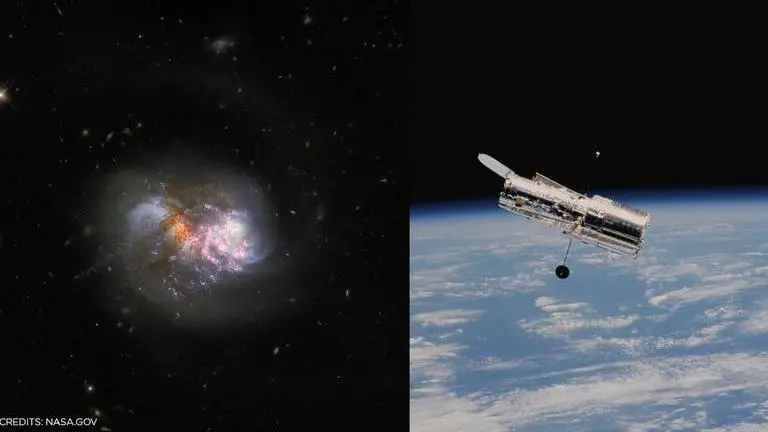
NASA has shared an image of a cataclysmic cosmic collision featuring an interacting galaxy pair that lies around 275 million years away in the constellation Cetus. Known as IC1623, the galaxy pair was discovered on November 19, 1897. On Friday, the US Space Agency shared a photo that features the pair approaching the final stages of a merging. “We expect a powerful inflow of gas to ignite a frenzied burst of star formation in the resulting compact starburst galaxy,” the astronomers said in a statement.
The spectacular image was clicked by NASA’s extraterrestrial telescope Hubble in 2008. For this purpose, Hubble used two filters at optical and infrared wavelengths on the Advanced Camera for Surveys. “This new image incorporates new data from the Wide Field Camera 3 (WFC3), and combines observations taken in eight filters spanning infrared to ultraviolet wavelengths to reveal the finer details of IC 1623,” NASA said. One of the two galaxies in the IC 1623 system has a substantial amount of warm and dense gas. This gas will eventually overlap the two nuclei, according to Scinews.
Future observations of the galaxy pair with the NASA/ESA/CSA James Webb Space Telescope will shed more light on the processes powering extreme star formation in environments such as IC 1623.

Image: Nasa.gov.
Hubble faces a glitch
This comes days after Hubble was hit owing to a technical glitch as confirmed by the US Space Agency. "Hubble has contributed greatly to our understanding of the universe over the past 30 years," said NASA in a press release.
Advertisement
The Hubble Space Telescope, which was launched in 1990 and changed the vision of the universe, has been down for the past few days, informed NASA. The problem is a payload computer that stopped working last Sunday and NASA insisted the telescope itself and scientific instruments that accompany it are "in good health".
“The payload computer’s purpose is to control and coordinate the science instruments and monitor them for health and safety purposes,” NASA said.