
NASA's Ironhand is game-changer for ISS astronauts and Earth's factory workers; Here's how
NASA in partnership with General Motors (GM) has developed the world’s first industrial-strength robotic glove called 'Ironhand'.
- Science News
- 3 min read

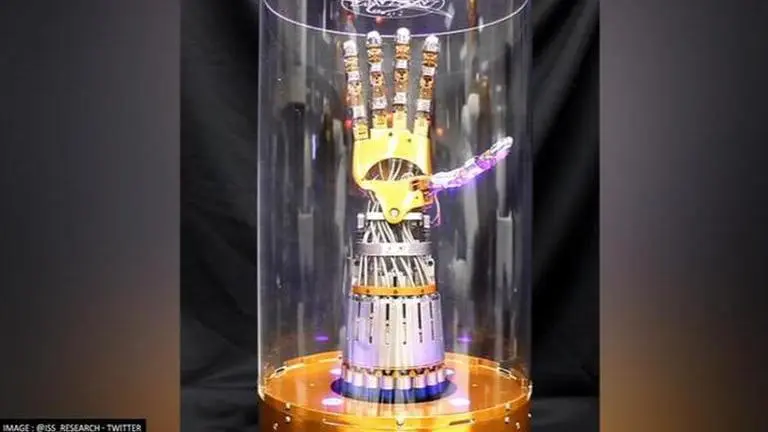
The workers, who work in a factory commonly experience the problem of fatigue and injury, with their hands being the most prone to the said problems. Astronauts living aboard the International Space Station (ISS) also face similar risks as they sometimes have to perform operations outside the laboratory during spacewalks. In a bid to overcome hand fatigue and potential injuries, NASA in partnership with General Motors (GM) has developed the world’s first industrial-strength robotic glove called 'Ironhand'.
What started as technology embedded in Robonaut 2’s robotic hand aboard the @Space_Station is now a @NASASpinoff being used in factories around the world to assist workers. https://t.co/lTdzBas2MZ pic.twitter.com/vTazSjcpSr
— ISS Research (@ISS_Research) January 25, 2022
According to NASA, the idea for a robotic hand is a result of the construction of Robonaut 2 (R2), which was developed under the 2006 Space Act Agreement with GM and flew to the ISS in 2011 to assist the astronauts in minor tasks.
How is Ironhand a game-changer?
The Ironhand, as mentioned above, has been developed to save the factory workers and astronauts from hand fatigue, which might result in injuries later. The idea of the robotic glove was explained by Jonathan Rogers, a mechanical design engineer at NASA’s Johnson Space Center. Once the Robonaut 2 was launched to the ISS, the team of engineers realised that they can use the same technology to transform it into a wearable device, the gloves in this case.

(Jonathan Rogers, now deputy chief of the Robotic Systems Technology Branch at Johnson Space Center, worked with a team of Johnson and GM engineers to build Robo-Glove, a robotic glove that could help manufacturing workers and astronauts alike. Image: NASA)
Advertisement
The argument was that performing repetitive tasks can lead to quality control problems. Rogers said that since robots are already doing tasks of heavy lifting in the factories, workers are more prone to hand injuries than shoulder or lower back ones. For the astronauts too, performing activities during hours-long spacewalk can result in aches and raw spots on the hands and even delaminated fingernails as their spacesuits, including the gloves, becomes a pressurized balloon. What this glove does is that it provides grasping strength which has solved problems in both worlds. So far there have been many versions of the robotic gloves owing to the partners such as General Motors and Sweden-based Bioservo Technologies NASA has had till now.
Now that NASA's partnership with GM has ended, it has partnered with an Australian natural gas company interested in deploying robots for dull, dirty, or dangerous field jobs using the R2 and Robo-glove technology. "It’s a huge win that came out of the glove. Any technology NASA comes up with that benefits society as a whole is a return on taxpayers’ investment", Rogers said in a statement.