
Updated 10 July 2022 at 15:49 IST
NASA's Lunar Trailblazer to launch in 2023; will hunt water for future colonies on Moon
NASA announced that its Lunar Trailblazer, scheduled for launch in 2023, achieved a major milestone and is one step closer to reaching the Moon.
- Science News
- 2 min read

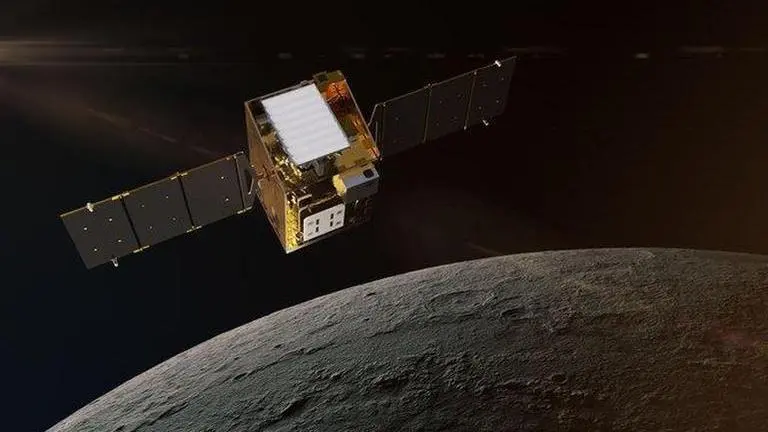
NASA, in its recent announcement, revealed that its Lunar Trailblazer mission has moved one step closer to its launch. Scheduled for liftoff in 2023, the mini orbiter will map the water on the lunar surface and determine its abundance, location and how it changes over time. Scientists are looking to locate and secure water on the Moon as it could prove to be a major asset for long-term human presence on the lunar surface.
Lunar Trailblazer, a @NASA SIMPLEx mission led by @Caltech, is planned for launch in 2023 to map water on the Moon’s surface and determine its abundance, location, form, and how it changes over time. One of Trailblazer’s 2 instruments recently passed a milestone at JPL. pic.twitter.com/0SGY2RDlZR
— NASA JPL (@NASAJPL) July 8, 2022
In the latest update, NASA's Jet Propulsion Laboratory (JPL), which is developing Trailblazer, said that one of the orbiter's instruments has passed a major milestone as it completed what is called the "cold alignment". Currently, in JPL's cleanroom, the High-resolution Volatiles and Minerals Moon Mapper (HVM3) is currently experiencing temperatures common in outer space. The JPL team also made fine adjustments so it will properly detect and measure infrared light absorbed by water.
"Mounted in a thermal vacuum chamber with detector chilled to -240°F (120K), the Trailblazer team made sure that the light of different wavelengths hit the correct parts of the detector through repeated adjustments until it was perfectly aligned", the JPL said in a statement.
Mounted in a thermal vacuum chamber with detector chilled to -240°F (120K), the Trailblazer team made sure that the light of different wavelengths hit the correct parts of the detector through repeated adjustments until it was perfectly aligned. More: https://t.co/k9U5TaHzH5 pic.twitter.com/FfJnSyS6CH
— NASA JPL (@NASAJPL) July 8, 2022
More about the lunar orbiter
Apart from the HVM3, the orbiter will be next fitted with a radiator to ensure the instrument maintains optimal operating temperatures while Trailblazer is in orbit around the Moon. Measuring 11.5 feet (3.5 meters) wide, the spacecraft will also be equipped with two solar panels. According to NASA, the Lunar Trailblazer was selected as part of the SIMPLEx (Small Innovative Missions for Planetary Exploration) program in 2019.
Advertisement
Prior to this, NASA will launch another mission to study the water trapped beneath the Moon's south pole. Named Lunar Flashlight, the mission involves a small satellite later that will use near-infrared lasers to determine if the lunar pole has liquid water and if it is enough to sustain future lunar colonies. "The mission will demonstrate our ability to use powerful, compact propulsive CubeSats for a variety of science missions at the Moon and across the solar system", Daniel Cavender, manager of the project said in a statement.
Published By : Harsh Vardhan
Published On: 10 July 2022 at 15:48 IST