
NASA's new instrument to map Earth's mineral dust composition takes first image from ISS
NASA, on Wednesday, shared a picture taken by the EMIT instrument which is installed outside the ISS to map the mineral composition of Earth's arid regions.
- Science News
- 2 min read

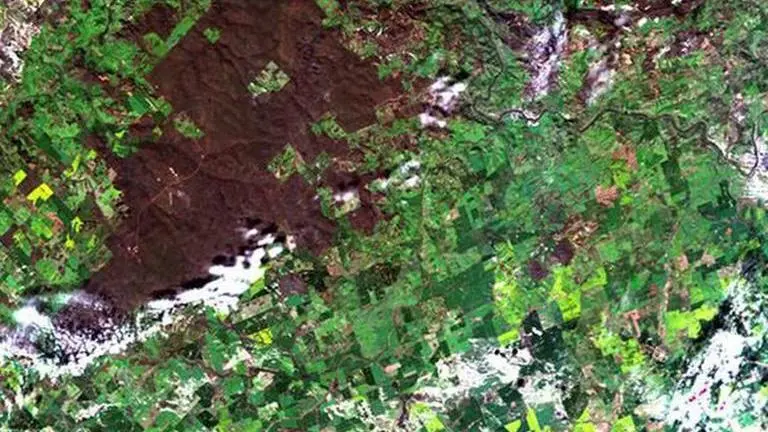
NASA, on Wednesday, shared the first picture taken by its Earth Surface Mineral Dust Source Investigation (EMIT) instrument. This instrument is installed on the exterior of the International Space Station (ISS) and will be used to map the mineral dust composition of Earth’s arid regions. NASA says that this would help scientists better understand how dust affects climate heating and cooling. Currently, scientists don't know if the dust minerals heat or cool the planet and the EMIT mission would help them answer this question.
Our mission to scan dust plumes in Earth's atmosphere is now operational on the @Space_Station. EMIT has taken its first scans while flying over Australia, mapping the dust makeup of the region to help scientists understand climate heating and cooling: https://t.co/JB56S7bLEQ pic.twitter.com/rfR3FdBv4h
— NASA (@NASA) August 2, 2022
What did EMIT see?

(The front of the image shows exposed soil (brown), vegetation (dark green), agricultural fields (light green), a small river, and clouds whereas the colours are the spectral fingerprints from corresponding spots; Image: NASA)
According to NASA, the image above named "first light" was taken at 8:21 am on July 28 when the space station passed over Western Australia. After EMIT's installment outside the ISS, the mission teams took the first measurements and translated them into what NASA calls an image cube. As shown above, the front portion of the image on the left features exposed soil (brown), vegetation (dark green), agricultural fields (light green), a small river, and clouds and the rainbow part of the image is the spectral fingerprints collected from the said regions.
Developed by NASA's Jet Propulsion Laboratory (JPL), the device has been developed to collect hundreds of wavelengths of light reflected from materials on Earth. Different materials are known to reflect different wavelengths of light, producing a kind of spectral fingerprint. Since EMIT is a spectrometer, it would collect the fingerprint allowing scientists to determine what the dust minerals are composed of.
Advertisement
NASA says that EMIT's primary mission begins this month and it will collect measurements of 10 important surface minerals such as hematite, calcite, dolomite, and gypsum, in arid and dust-producing regions of Africa, Asia, North and South America, and Australia. The installation process of EMIT was completed on July 24 after 40 hours of continuous work using the Canadarm2 robotic arm of the space station.
This robotic arm, removed the instrument from SpaceX's Dragon spacecraft to place it into its intended location. NASA even shared a time-lapse video of the high-precision installation process.