
NASA's OSIRIS-REx nears historic asteroid sample delivery but big challenges await
NASA's OSIRIS-REx spacecraft is scheduled to land on Earth in September but there are major challenges to be dealt with before uncovering solar system secrets.
- Science News
- 3 min read

;'%3e%3cpath%20d='m8,15.99c4.41,0,7.99-3.58,7.99-7.99S12.41,0,8,0,0,3.59,0,8s3.58,7.99,7.99,7.99Z'%20style='stroke:%23fff;%20stroke-miterlimit:10;%20stroke-width:.02px;'/%3e%3cpath%20d='m3.08,3.37l3.82,5.11-3.84,4.15h.87l3.37-3.64,2.72,3.64h2.94l-4.04-5.39,3.58-3.87h-.86l-3.1,3.35-2.5-3.35h-2.94Zm1.27.64h1.35l5.97,7.99h-1.35l-5.97-7.99Z'%20style='fill:%23fff;'/%3e%3c/g%3e%3c/svg%3e)


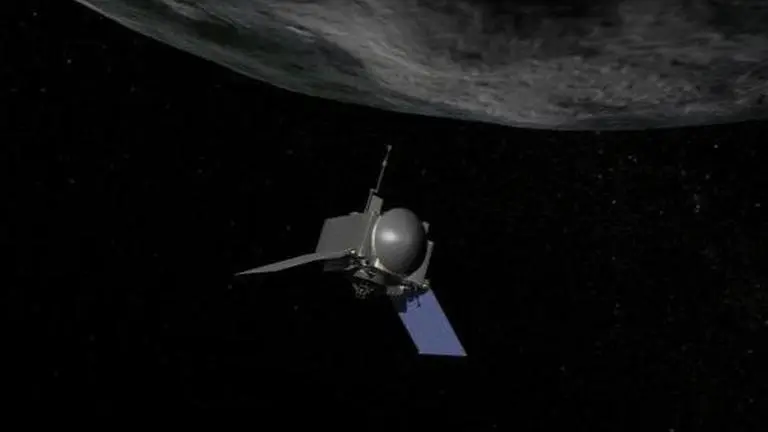
NASA's OSIRIS-REx spacecraft has spent almost seven years in space and is inching closer to delivering the asteroid samples it collected later this year. Short for Origins Spectral Interpretation Resource Identification Security - Regolith Explorer, OSIRIS-REx was launched on September 9, 2016, and collected samples from asteroid Bennu in 2020.
According to NASA, it will land in a desert in Utah at around 8:24 pm IST on September 24, and the sample recovery process is something the mission controllers are extremely serious about.
NASA prepares for big challenges lying ahead
After 7 years in space, the #OSIRISREx mission is just 6 months away from one of its biggest challenges yet: deliver an asteroid sample to Earth while protecting it from damage & contaminants. Here's how the team is preparing: https://t.co/jB8ORXRHnF
— NASA Solar System (@NASASolarSystem) March 24, 2023
#ToBennuAndBack pic.twitter.com/N8A6jGzayH
Once the spacecraft enters the Earth's atmosphere, one of the major challenges would be protecting the sample capsule from the atmospheric heat. If OSIRIS-REx fails to release the capsule as planned, the team will divert it away from Earth and try again in 2025 as a backup plan. The capsule is supposed to timely separate from the main spacecraft and use its heatshield and parachutes to land safely.
The next challenge, NASA outlines, is protecting the sample from contaminants on Earth so as to study them in their most raw form. Notably, OSIRIS-REx (20 feet X 8 feet) is bringing 250 grams +/- 101 grams of Bennu's contents and scientists want to examine them as asteroids are believed to be leftovers from the early era of planet formation.
Advertisement
Besides, they are believed to contain molecular precursors to life and experts want to confirm if asteroids brought certain biological compounds to Earth billions of years ago. Jason Dworkin, OSIRIS-REx project scientist, says that pure meteorites that crash into our planet are contaminated by water and biology. "A pristine sample could provide insights into the development of solar system," he said in a statement.
How is NASA preparing?
NASA says that its teams will practice rigorously for the next six months to ensure the successful completion of the OSIRIS-REx mission. In the following months, they will practice recovery procedures to procure the samples safely without any contamination. Currently, they are rehearsing to unpack and process the samples at NASA's Johnson Space Center, the same facility where a new lab has been built specially to study the arriving material.
Advertisement
NASA says that some of the samples will be distributed to research teams around the world and preserve the rest for future studies. It is worth noting that this is not the first time asteroid samples will be delivered to Earth, as Japan was the first to do it when its Hayabusa 2 mission fetched 5 grams of soil in November 2019.

(Asteroid Ryugu photographed by Hayabusa2; Image: NASA)