
NASA's Parker Probe enters hostile environment around the Sun during its 13th encounter
NASA’s Parker probe will be 8.5 million km from the sun during its 13th closest approach and scientists are hopeful that it might pass through solar flares.
- Science News
- 2 min read

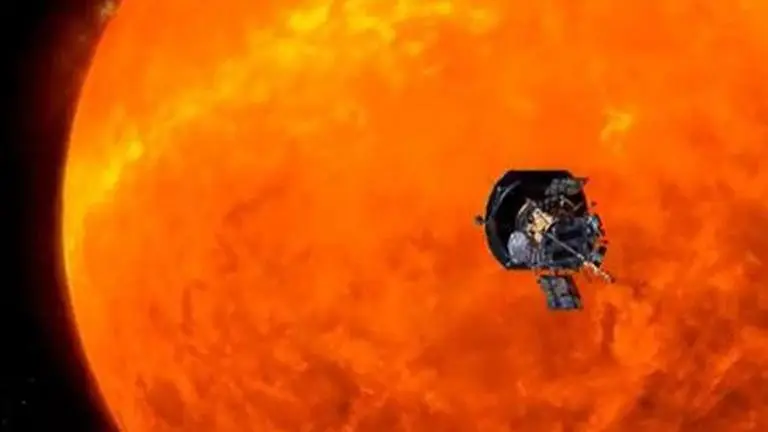
NASA’s Parker probe, starting September 6, is at its closest to the Sun and is enduring a much different solar environment than ever. The US space agency says that this is the probe's 13th perihelion or a close encounter with the Sun but it will face more intense conditions due to the increased solar activity. Astronomers have recently spotted a huge sunspot, as big as the Earth, which has triggered multiple solar flares and geomagnetic storms.
Today is #ParkerSolarProbe's 13th perihelion, or close encounter with the Sun! This time, the spacecraft is heading into a much different solar environment than ever before. Learn more: https://t.co/9HmfphpEzb pic.twitter.com/ZvGmHxGmwA
— NASA Sun & Space (@NASASun) September 6, 2022
At the time of its perihelion, the Parker probe would be just 8.5 million km (5.3 million miles) from the sun and scientists are hopeful of gathering new data during a worse solar environment.

(Parker solar probe's position; Image: NASA)
"The Sun has changed completely since we launched Parker Solar Probe (in August 2018) during solar minimum when it was very quiet,” said Nour Raouafi, Parker Solar Probe project scientist at the Johns Hopkins Applied Physics Laboratory (APL). "When the Sun changes, it also changes the environment around it. The activity at this time is way higher than we expected.”
Advertisement
Interestingly, NASA scientists said that they are awaiting something groundbreaking after the probe will pass through a solar flare or a coronal mass ejection (CME) during one of its close encounters. "Nobody has ever flown through a solar event so close to the Sun before,” the scientist said. “The data would be totally new, and we would definitely learn a lot from it.”
Time is almost up to submit white papers to the heliophysics decadal survey by Sept. 7! ⌛ This survey aims to identify cutting-edge, interdisciplinary science problems that push the boundaries of what was thought possible in solar and space physics. ➡️ https://t.co/l0CGDrkxqo pic.twitter.com/pTYpgVoAMY
— NASA Sun & Space (@NASASun) September 7, 2022
It is worth noting, however, that the Wide-field Imager for Solar Probe (WISPR) instrument has imaged a small number of CMEs from a distance, the one during its 10th encounter in November 2021 being the most recent. The spacecraft is conducting periodic flybys of the sun to help scientists better predict space weather, which can affect electric grids, communications and navigation systems, astronauts and satellites in space.
Advertisement
In order to last long enough, NASA has built the spacecraft extremely durable as its heat shield can withstand temperatures as high as 1,650°C. "Parker Solar Probe is built to withstand whatever the Sun can throw at it,” said Doug Rodgers, APL’s science operations center coordinator for the mission. “Every orbit is different, but the mission is a well-oiled machine at this point.”