
Updated 1 March 2022 at 22:17 IST
NASA's releases new Hubble snap featuring 'lone wolf' galaxy filled with cosmic fossil
NASA's classic image captured by the Hubble space telescope features the elliptical galaxy named NGC 1132 located about 318 million light-years away.
- Science News
- 2 min read

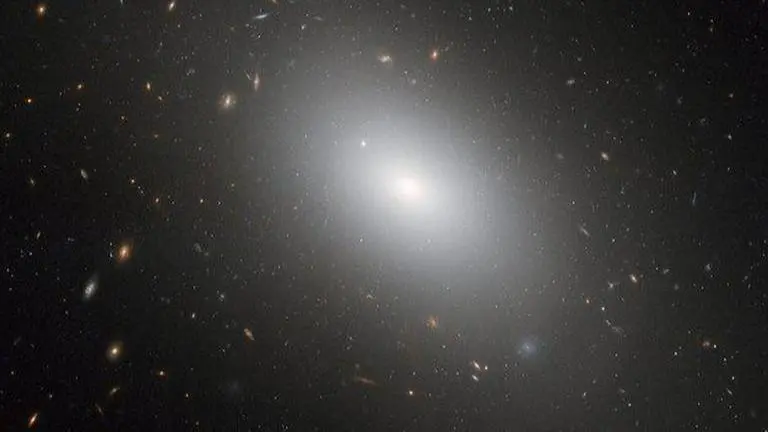
The Hubble team is back to feast our eyes with another cosmic phenomenon wrapped up in a classic image captured by NASA’s Hubble space telescope. The photograph features the elliptical galaxy NGC 1132, which according to the Hubble team, might have formed after a group of galaxies merged together in the recent past. Located approximately 318 million light-years away, the galaxy NGC 1132 lies in the constellation Eridanus, the River.
Elliptical galaxies, like NGC 1132 in this #HubbleClassic image, contain hundreds of millions to trillions of stars.
— Hubble (@NASAHubble) February 28, 2022
Ranging from nearly spherical to elongated shapes, elliptical galaxies’ yellowish color comes from their aging stars.
Read more: https://t.co/1NI4YoLt7Y pic.twitter.com/QcRcwbr9kA
"In this Hubble image, NGC 1132 is seen among a number of smaller dwarf galaxies of similar colour. In the background, there is a stunning tapestry of numerous galaxies that are much larger but much farther away", said the Hubble team in its report.
Mystery galaxy contains cosmic fossil
NASA said that there are two theories that could explain how this galaxy came into existence. The first theory suggests that many different galaxies merged into one to form NGC 1132 while the other suggests that the galaxy formed in isolation as a "lone wolf" separate from different galaxy groups and clusters.
Astronomers have dubbed it the "fossil group" because of the enormous concentration of dark matter in comparison to the dark matter found in an entire group of galaxies. "NGC 1132 also has a strong X-ray glow from an abundant amount of hot gas that is normally only found in galaxy groups," the Hubble team said in a report.
Advertisement
What's interesting, is that the galaxy appears as a single, isolated, large elliptical galaxy in visible light. Such galaxies are smooth and featureless and contain hundreds of millions to trillions of stars. In addition to this, their shape ranges from nearly spherical to very elongated. As for their colours, they appear to have a yellowish glow which can be accredited to ageing stars. Elliptical galaxies normally have old stars as they do not contain much cool gas and this prevents the formation of new stars.
(Image: @NASAHubble/Twitter)
Published By : Harsh Vardhan
Published On: 1 March 2022 at 22:17 IST