
NASA's shoe box-sized CubeSat will investigate water on the Moon during Artemis I
NASA is planning to take full advantage of the Artemis I mission which would be launched to the Moon on August 29 from the Kennedy Space Center.
- Science News
- 3 min read

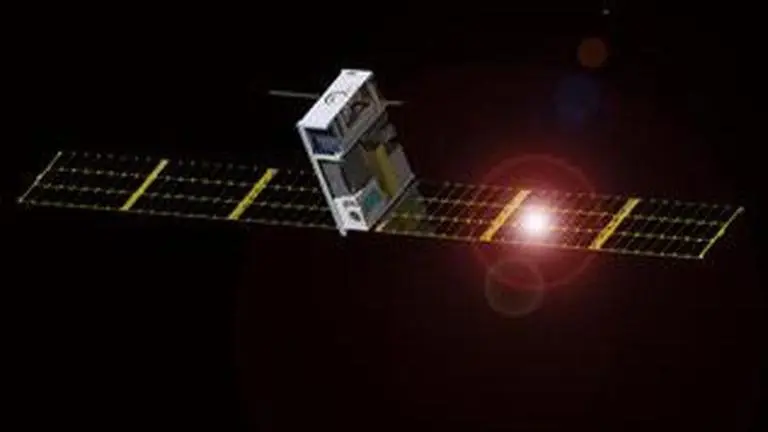
With the Artemis I launch, which is targeted for August 29, NASA is planning to take full advantage of the pioneering mission which would begin the agency’s quest to land astronauts on the Moon again. While the Orion spacecraft, mounted atop the Space Launch System (SLS) rocket will be the primary payload, NASA is sending secondary payloads in the form of ten small CubeSats with different objectives.
NASA’s water-scouting CubeSat, Lunar IceCube, will be hitching a ride on #Artemis I. 🛰️
— NASA_SLS (@NASA_SLS) August 9, 2022
Once launched, the spacecraft will enter a lunar orbit and use a spectrometer to investigate lunar ice. 🧊
Learn more HERE>> https://t.co/wykIDCTuQF pic.twitter.com/saOvalMDOZ
One of these CubeSats is the Lunar Icecube to investigate lunar ice and located water on the Moon. This payload, which is no bigger than a shoe box and weighs 14 kg, has been integrated into the SLS rocket and will use its BIRCHES (Broadband InfraRed Compact High-Resolution Exploration Spectrometer) instrument to determine the distribution of water and other organic volatiles. A spectrometer is a device that is used to study different wavelengths of light and extract information stored in it.
“Lunar IceCube will help pave the way for human missions through significantly less expensive robotic missions and by addressing water dynamics on the Moon”, Mark Lupisella, exploration research and development manager, said in an official statement. “This is not only important for science, but it could also be important for reducing the cost of human missions over the long-term”.
According to NASA, scientists are particularly interested in the absorption and release of water from the Moon’s regolith and are aiming to map these changes through Lunar Icecube’s investigations. Besides, the CubeSat will also be used to study the thin atmosphere-like volume surrounding the Moon called the exosphere. Scientists believe that by understanding the dynamics of water and other substances on the Moon, they will be able to predict seasonal changes in lunar ice as well as the impact it could have on its usability in the future.
Advertisement
More about Artemis I
The Artemis I launch is targeted for August 29 and NASA will roll the SLS rocket out to the launch pad at the Kennedy Space Center on August 17. If the launch is conducted on the planned date, the Orion spacecraft will be propelled toward the Moon for a mission that would last for a few weeks. During this time, the mission teams would evaluate the performance of the SLS rocket, the Orion spacecraft, and the ground systems.
Notably, three mannequins are also strapped inside the spacecraft to gather data on the effects of outer space during lunar launch and Orion's capabilities to protect the astronauts from harmful radiation.