
NASA’s Webb Telescope releases new image of ice giant Uranus in spectacular detail
NASA’s James Webb Space Telescope has taken an astounding image of the seventh planet from the Sun, Uranus.
- Science News
- 3 min read

;'%3e%3cpath%20d='m8,15.99c4.41,0,7.99-3.58,7.99-7.99S12.41,0,8,0,0,3.59,0,8s3.58,7.99,7.99,7.99Z'%20style='stroke:%23fff;%20stroke-miterlimit:10;%20stroke-width:.02px;'/%3e%3cpath%20d='m3.08,3.37l3.82,5.11-3.84,4.15h.87l3.37-3.64,2.72,3.64h2.94l-4.04-5.39,3.58-3.87h-.86l-3.1,3.35-2.5-3.35h-2.94Zm1.27.64h1.35l5.97,7.99h-1.35l-5.97-7.99Z'%20style='fill:%23fff;'/%3e%3c/g%3e%3c/svg%3e)


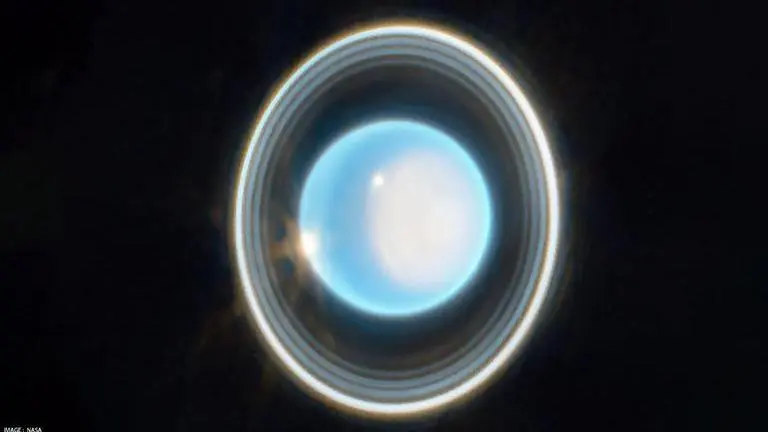
NASA’s James Webb Space Telescope has taken an astounding image of the seventh planet from the Sun, Uranus, following in the footsteps of the Neptune image released in 2022.
The new image of the Solar System’s ice giant features rings as well as bright formations in the planet’s atmosphere. Only two other facilities have ever observed the faintest dusty rings: The Voyager 2 spacecraft when it passed the planet in 1986 and the Keck Observatory with cutting-edge adaptive optics. The Webb data exhibited the observatory's unprecedented sensitivity to these rings.
Uranus. (Go ahead, get it out of your system. We tried.)
— NASA (@NASA) April 6, 2023
Only Voyager 2 in the 1980s & Keck (with adaptive optics) have imaged the planet's rings before, and they've never been this clear. @NASAWebb highlights atmospheric features & 11 of its 13 rings: https://t.co/oWpw1ekldE pic.twitter.com/m5upNQKEEX
Why is Uranus unique?
Uranus rotates on its side at a 90-degree angle from the plane of its orbit. Since the poles of the planet alternate between long stretches of uninterrupted sunlight and an equivalent interval of total darkness, this results in extreme seasons.
The planet orbits the Sun in 84 Earth years. The northern summer of Uranus will occur in 2028, it is currently late spring at the northern pole. In contrast, it was summer at the south pole when Voyager 2 travelled to Uranus. The south pole is currently hidden from view and faces the darkness of space on the planet's "dark side."
Advertisement

(Image: NASA)
This infrared image from Webb's NIRCam (near-infrared camera) combines information from two filters at 1.4 and 3.0 microns, which are represented in blue and orange, respectively. The representative-colour image that results shows a blue hue on the planet.
Advertisement
When Voyager 2 turned to face Uranus, its camera captured a nearly featureless blue-green orb in the visible wavelength. The infrared wavelengths and enhanced sensitivity of Webb allow us to see more detail, demonstrating how active Uranus' atmosphere really is.
A polar cap, or region of brightening at the pole facing the Sun, can be seen on the right side of the planet. These Webb data will aid scientists in unravelling the currently unfathomable process behind this peculiar polar cap that appears on Uranus in the summer when the pole is exposed to direct sunlight and disappears in the fall. The polar cap's slightly enhanced brightness in the middle was a startling feature that Webb revealed. Other powerful telescopes, including the Hubble Space Telescope and Keck Observatory, have not been able to view this increased Uranus polar feature as vividly as Webb's NIRCam due to its sensitivity and longer wavelengths.
A second very bright cloud is seen at the planet's left limb, and there is a bright cloud at the edge of the polar cap as well as a few fainter extended structures just beyond the border of the cap. Such clouds are typical of Uranus in the infrared, and they probably correspond to storm activity.
According to reports, Webb will solve mysteries in the solar system, look beyond distant worlds around other stars, and probe the mysterious structures and origins of our universe and our place in it. Webb is an international programme led by NASA with its partners, the ESA (European Space Agency) and the Canadian Space Agency.