
NASA’s Webb telescope detects water on WASP-96b; know more about the puffy exoplanet
NASA revealed that the James Webb Space Telescope's observations of the exoplanet WASP-96b have revealed details about its atmosphere for the first time.
- Science News
- 3 min read

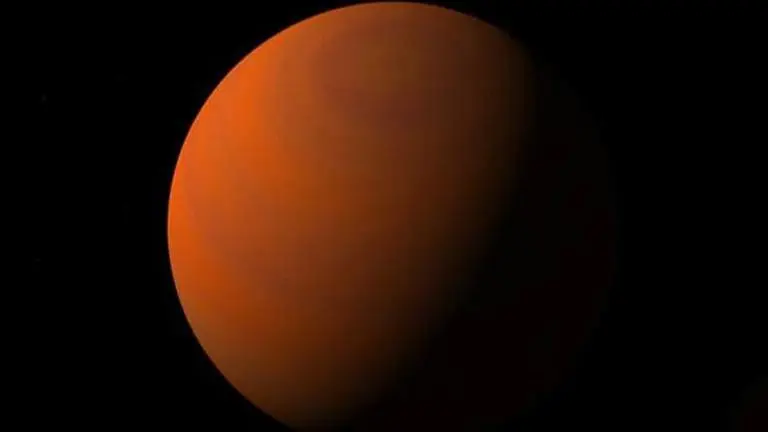
The James Webb Space Telescope has begun its scientific operations starting July 12 and has made significant discoveries already. Yesterday, NASA released images of five different celestial entities along with the elements Webb detected in and around those entities during its observations.
While every information revealed by the telescope was a first, one such revelation was about a watery atmosphere of a hot and puffy gaseous planet that is orbiting a distant sun-like star. Let us take a look at what makes this planet and the overall significance of Webb’s discovery.
Clouds on another world. @NASAWebb captured the signature of water on giant gas planet WASP 96-b, which orbits a star 1,150 light-years away. For the first time, we've detected evidence of clouds in this exoplanet's atmosphere: https://t.co/63zxpNDi4I #UnfoldTheUniverse pic.twitter.com/f3HOX0HKis
— NASA (@NASA) July 12, 2022
About the planet WASP-96b
The planet in focus is the WASP-96b which lies roughly 1,500 light-years away and is located in the southern-sky constellation named Pheonix. According to NASA, Webb has captured the distinct signature of water along with the evidence of cloud and haze in this hot world’s atmosphere.
Interestingly, this exoplanet orbits its star from just one-ninth of the distance between Mercury and the sun and a year here lasts just three-and-a-half days. Needless to say, a planet orbiting its star would have an extremely high surface temperature, around 537 degrees Celsius, and is much more inflated as compared to other planets. Another surprising characteristic of WASP-96b is its mass, which is about less than half of Jupiter but has a size 1.5 times greater than the latter.
Advertisement
Webb breaks down WASP-96b’s atmosphere
NASA says that apart from the aforementioned properties that were determined after previous observations, the Webb telescope provided details about WASP-96b’s atmosphere completely hidden previously. The discoveries were made using one of Webb’s instruments- the Near-Infrared Imager and Slitless Spectrograph (NIRISS)- and the milestone included detecting the unambiguous signature of water, indications of haze, and evidence of clouds.
The primary objectives of NIRISS include first light detection, exoplanet detection and characterization, and exoplanet transit spectroscopy. In this case, it measured light from the WASP-96 system for 6.4 hours as the planet moved across the star. The result of NIRISS’ observation was a light curve that showed the overall dimming of starlight as the exoplanet transited its star and a transmission spectrum, using which the scientists were able to detect and measure the abundances of key gases in the planet’s atmosphere.
Advertisement
In simple terms, the transmission spectrum is produced by comparing the starlight filtered through a planet’s atmosphere, when the planet crosses its star’s face, to the unfiltered light. NASA says while Webb has detected water in WASP-96b’s atmosphere, scientists are also optimistic about finding oxygen, methane, and carbon dioxide in other planets Webb will observe later on.