
Updated 29 March 2022 at 20:46 IST
Perseverance rover's new milestone: Scientists calculate speed of sound on Mars
NASA's Perseverance rover helped scientists calculate the speed of sound on Mars using a laser and the Perseverance rover's SuperCam microphone.
- Science News
- 2 min read

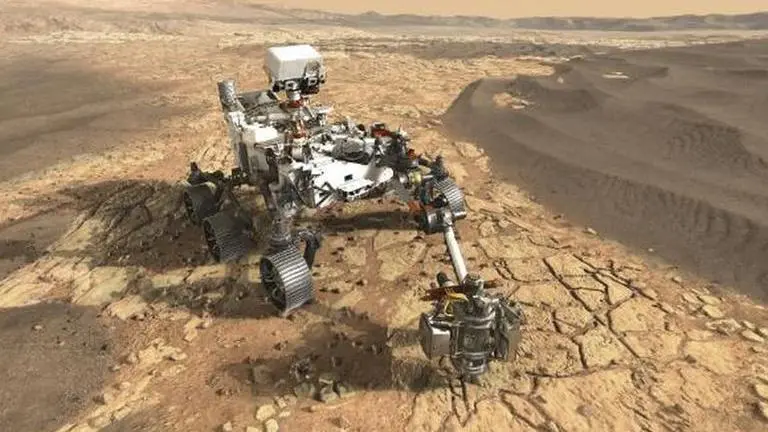
NASA engineers controlling the Perseverance rover have a new reason to celebrate as the robot, has now helped them calculate the speed of sound on Mars. The milestone was achieved using a laser and the Perseverance rover's SuperCam microphone along with clever calculations. It is worth noting that the speed of sound varies across the universe as it largely depends on the density of the medium it is travelling through. The more dense a medium is, the faster the sound travels through it.
How fast is the speed of sound on Mars?
According to the paper presented by scientists at the 53rd Lunar and Planetary Science Conference earlier in March, it was revealed that the speed of sound on Mars is 240 meters per second or 787 feet per second. This is significantly less than the speed on Earth as sound travels at 340 metres per second or 1,125 feet per second. This is a result of low atmospheric pressure on Mars, which is 0.095 pounds per square inch (psi) at the ground level as compared to Earth's 14.7 psi at sea level.
The engineers were able to measure the speed of sound on Mars by calculating the time it took for the laser-induced acoustic sound to reach Perseverance's microphone. The laser is mounted about 2.1 metres above the Martian surface and is used by scientists to study the Martian rocks and the overall geology of the planet. A report by Gizmodo revealed that the calculations were made using 150 laser shots which were fired in five different locations.
The study also found that higher-pitched sound travels faster on Mars and the only planet having variation in speed of sound. According to Interesting Engineering, the experts wrote in their report, "Due to the unique properties of the carbon dioxide molecules at low pressure, Mars is the only terrestrial-planet atmosphere in the Solar System experiencing a change in speed of sound right in the middle of the audible bandwidth (20 Hertz to 20,000 Hertz)". Scientists say that this unique characteristic of sound would provide a "unique listening experience".
Advertisement
Image: NASA/JPL
Published By : Harsh Vardhan
Published On: 29 March 2022 at 20:46 IST