
Redwire Space to open 1st commercial greenhouse for crop production aboard ISS
Redwire Space announced that it will open a commercial greenhouse aboard ISS in 2023 to support in-space plant research and commercial crop production on Earth.
- Science News
- 3 min read

;'%3e%3cpath%20d='m8,15.99c4.41,0,7.99-3.58,7.99-7.99S12.41,0,8,0,0,3.59,0,8s3.58,7.99,7.99,7.99Z'%20style='stroke:%23fff;%20stroke-miterlimit:10;%20stroke-width:.02px;'/%3e%3cpath%20d='m3.08,3.37l3.82,5.11-3.84,4.15h.87l3.37-3.64,2.72,3.64h2.94l-4.04-5.39,3.58-3.87h-.86l-3.1,3.35-2.5-3.35h-2.94Zm1.27.64h1.35l5.97,7.99h-1.35l-5.97-7.99Z'%20style='fill:%23fff;'/%3e%3c/g%3e%3c/svg%3e)


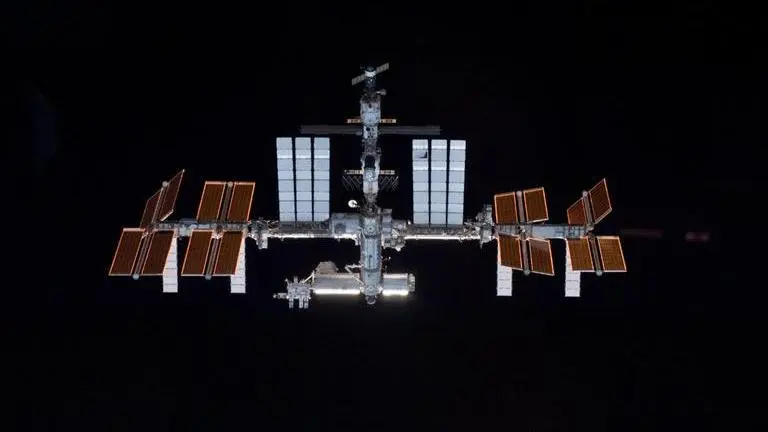
US-based aerospace company Redwire Space has announced its plan to open the world’s first commercial greenhouse aboard the International Space Station (ISS). In its official statement released earlier this week, the company said that the platform is targeted for launch in 2023 and that the in-space demonstration will validate its “concept of operations and evaluate its lighting, ventilation and leaf litter containment capabilities”.
According to Redwire, its greenhouse will aim for growing plants from seed to maturity and the platform will benefit commercial crop production on Earth as well as ensure food security for future space exploration missions.
We are pleased to announce that we are developing the first-ever commercial space greenhouse on @Space_Station, which will enable industrial research to benefit commercial crop production on Earth + improve future space exploration mission sustainability: https://t.co/EMu33qWTbT pic.twitter.com/0H5csnE5bK
— Redwire Space (@RedwireSpace) August 16, 2022
Redwire Space's inaugural flight to the ISS
According to Redwire, commercial agricultural technology company Dewey Scientific will be its first customer for the inaugural flight of the greenhouse to the ISS. During its first phases of experiments, Dewey Scientific will grow the 'industrial hemp' plant in the greenhouse for a gene expression study. Estimated to last 60 days, this experiment will demonstrate the capabilities of the facility, while advancing biomedical and biofuels research.
Redwire says that it already has flight-qualified plant growth technology, including Passive Orbital Nutrient Delivery System (PONDS) devices, which are being operated aboard the ISS. If the inaugural testing phase yields positive results, the company will launch larger and scalable versions of the greenhouse for customers with varying crop-growing requirements or alternate plant support systems.
Advertisement
Notably, one of the company's objectives is to provide access to institutional and commercial customers with various plant research goals as well as support long-term NASA exploration plans. "Increasing the throughput of crop production research in space, through commercially developed capabilities, will be important to deliver critical insights for NASA’s Artemis missions and beyond", Dave Reed, Greenhouse project manager, said in an official statement.
Vote on which space crop sounds tastiest to you ⬇️
— NASA Space Science (@NASASpaceSci) August 11, 2022
Mizuna mustard greens, red romaine lettuce, chile peppers, & radishes are just a few of the plant varieties we’ve grown aboard @Space_Station and in our ground facilities at @NASAKennedy. pic.twitter.com/1YpLnrP8IW
This, however, will not be the first time plant growth will take place in space, as the astronauts have been doing it for years now. So far, several plants including lettuce, Chinese cabbage, mizuna mustard, red Russian kale, and chili pepper have been grown aboard the space station. Scientists are doubling down on plant growth in space to ensure food security for astronauts who would one day embark on deep-space missions as well as for those who would settle in the bases on Moon and eventually on Mars.
Advertisement
Mastering the technology of space agriculture, that too, using resources such as lunar and Martian soil would reduce the dependence on fertile soil and spare the burden of extra payloads carried on space missions. Currently, scientists are even figuring out a way to grow plants through solutions such as aeroponics and hydroponics which make minimal use of conventional growth mediums such as soil and water.