
Revealing Mysteries of Cat’s Eye Nebula: Deep Dive into One of Universe’s Most Complex Nebulae
The Cat's Eye Nebula is a complex, stunning planetary nebula with intricate concentric rings, offering insight into the final stages of a star's evolution.
- Science News
- 2 min read

;'%3e%3cpath%20d='m8,15.99c4.41,0,7.99-3.58,7.99-7.99S12.41,0,8,0,0,3.59,0,8s3.58,7.99,7.99,7.99Z'%20style='stroke:%23fff;%20stroke-miterlimit:10;%20stroke-width:.02px;'/%3e%3cpath%20d='m3.08,3.37l3.82,5.11-3.84,4.15h.87l3.37-3.64,2.72,3.64h2.94l-4.04-5.39,3.58-3.87h-.86l-3.1,3.35-2.5-3.35h-2.94Zm1.27.64h1.35l5.97,7.99h-1.35l-5.97-7.99Z'%20style='fill:%23fff;'/%3e%3c/g%3e%3c/svg%3e)


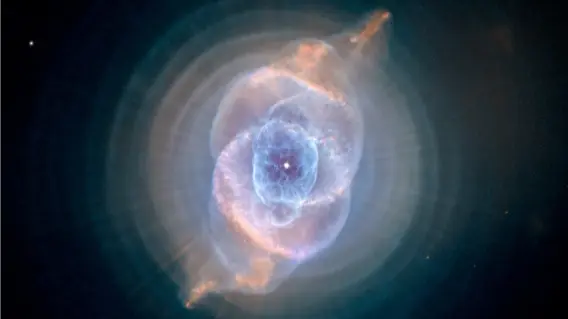
NASA has again dropped an unseen image of a galaxy situated hundreds of light years away from our planet. The name of this galaxy is Cat’s Eye Nebula and it was one of the first planetary nebulae which was discovered and according to NASA it is one of the meow-st complex ones ever seen.
The Cat's Eye Nebula, also known as NGC 6543, is one of the most complex and intriguing planetary nebulae ever observed. Discovered early in astronomical history, this nebula continues to captivate scientists and stargazers alike with its intricate structure and stunning beauty.
A Nebula with a Unique Bullseye Pattern
Though the Cat’s Eye Nebula was one of the first planetary nebulae to be discovered, it remains one of the most complex ones ever seen. NASA's Hubble Space Telescope has captured its complexities in great detail, highlighting a bullseye pattern of eleven or more concentric rings, or shells. Each ‘ring’ is actually the edge of a spherical bubble seen projected onto the sky. Observations suggest the star ejected its mass in a series of pulses at 1,500-year intervals. These convulsions created dust shells, each of which contains as much mass as all the planets in our solar system combined.
What Are Planetary Nebulae?
Planetary nebulae represent a unique category of nebulae. They got their name because when they were first observed through early telescopes, they resembled planets. However, a planetary nebula is the final stage in the evolution of a star that is similar to our Sun.
Advertisement
Theories Behind the Bullseye Pattern
Several explanations have been proposed for the bullseye patterns seen around planetary nebulae like the Cat’s Eye, including:
- Cycles of magnetic activity similar to the Sun's sunspot cycle
- The action of a companion star orbiting around the dying star
- Stellar pulsations
Another school of thought is that the material is ejected smoothly from the star, and the rings are created later due to waves forming in the outflowing material. Further observations and more theoretical studies are needed to decide between these and other purr-tential explanations.
Advertisement
A Cosmic Masterpiece
The Cat's Eye Nebula continues to be a focal point of study, as its mysterious and intricate design challenges our understanding of stellar evolution. Whether you’re an astronomer or just someone who loves to gaze at the stars, the Cat's Eye Nebula is a reminder of the breathtaking beauty that lies within our universe.