
Rocket Lab catches freefalling rocket booster with helicopter in 1st ever historic launch
Rocket Lab's Electron rocket lifted off at 4:19 am (IST) under the mission named ‘There and Back Again’ to deliver 34 satellites to a sun-synchronous orbit.
- Science News
- 2 min read

;'%3e%3cpath%20d='m8,15.99c4.41,0,7.99-3.58,7.99-7.99S12.41,0,8,0,0,3.59,0,8s3.58,7.99,7.99,7.99Z'%20style='stroke:%23fff;%20stroke-miterlimit:10;%20stroke-width:.02px;'/%3e%3cpath%20d='m3.08,3.37l3.82,5.11-3.84,4.15h.87l3.37-3.64,2.72,3.64h2.94l-4.04-5.39,3.58-3.87h-.86l-3.1,3.35-2.5-3.35h-2.94Zm1.27.64h1.35l5.97,7.99h-1.35l-5.97-7.99Z'%20style='fill:%23fff;'/%3e%3c/g%3e%3c/svg%3e)


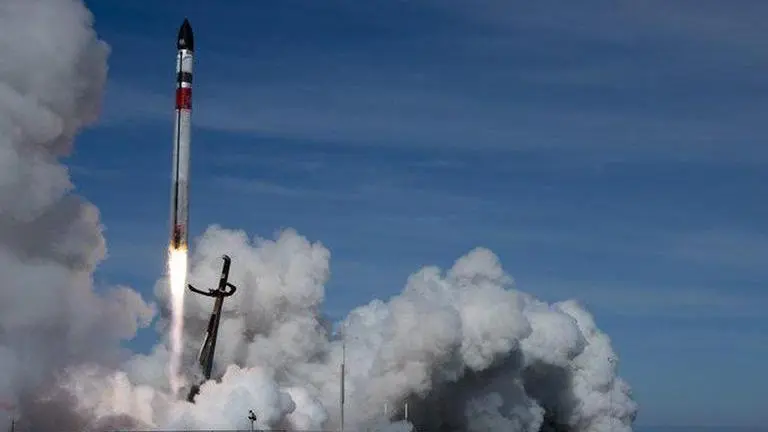
Putting weeks of anticipation to an end, Rocket Lab finally launched its Electron rocket from Pad A at Launch Complex 1 on New Zealand’s Māhia Peninsula on May 3 for its one-of-a-kind mission. The rocket lifted off at 4:19 am (IST) under the mission named ‘There and Back Again’ to deliver 34 satellites to a sun-synchronous orbit for a number of private customers. However, the highlight of the mission remained the post-launch event, wherein a helicopter grabbed the massive Electron rocket booster during a freefall.
Payloads deployed! MISSION SUCCESS for our 26th Electron launch. Congratulations to our mission partners. It is an honor to help you get to space. #ThereAndBackAgain pic.twitter.com/DFK3bpyTFp
— Rocket Lab (@RocketLab) May 2, 2022
Rocket Lab nails first thrilling mission
It is worth noting that this was Rocket Lab’s first attempt at grabbing a free-falling rocket booster using a helicopter. The mission began with the Electron rocket, which completed its 26th overall flight, lifting off from the launch pad which then separated from the satellite-laden second stage two minutes 60 seconds after launch.
This is what it looked like from the front seats. pic.twitter.com/AwZfuWjwQD
— Peter Beck (@Peter_J_Beck) May 3, 2022
According to the mission planning, the booster was to deploy its parachute after gliding toward the Pacific ocean following the satellite launch. The helicopter, on the other hand, tasked with catching the booster, was deployed 280 kilometers off the New Zealand coast. The California-based firm used a customised Sikorsky S-92 chopper which is generally used for offshore oil gas transport as well as search and rescue operations.
Homeward bound, safe and sound. pic.twitter.com/j159KRKQb5
— Peter Beck (@Peter_J_Beck) May 3, 2022
Rocket Lab, in its official statement, informed that the chopper rendezvoused with the booster at 6,500 feet and grabbed the booster with a hook. The parachute was deployed in order to reduce the free-falling booster’s descent velocity to 36 kilometers per hour, which made it convenient for the chopper to nail a catch. Following the successful mission, the booster was loaded onto a recovery vessel and hauled back to the coast.
Advertisement
Rocket Lab founder and CEO, Peter Beck, said in a statement “from here we’ll assess the stage and determine what changes we might want to make to the system and procedures for the next helicopter catch and eventual re-flight”. The rocket-making company’s bold attempt was its step toward making the Electron a reusable rocket to increase launch frequency and reduce launch costs for small satellites. With the latest deployment, the number of satellites launched by Rocket Lab reached 146 and its latest list of customers included Alba Orbital, Astrix Astronautics, Aurora Propulsion Technologies, E-Space, Spaceflight, and Unseenlabs.