
Rocket Lab to catch falling booster using a Helicopter on November 4; Watch live action
Rocket Lab's satellite launch mission is scheduled to launch at 10:45 pm IST during a 75-minute window on November 4 from New Zealand.
- Science News
- 2 min read

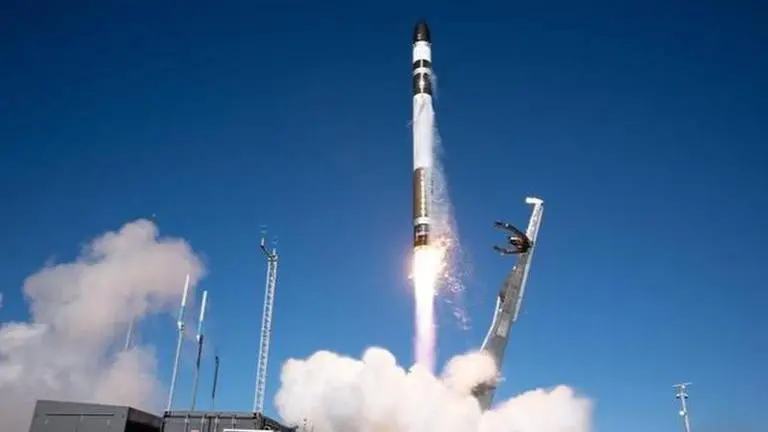
Rocket Lab is ready for a thrilling satellite launch mission which involves catching a free-falling booster using a Helicopter. The mission is scheduled to launch at 10:45 pm IST during a 75-minute window on November 4 from Rocket Lab's Launch Complex 1 in New Zealand aboard the Electron rocket. Named ‘Catch Me If You Can’, the mission would mark Rocket Lab’s 32nd Electron launch overall and second reusability mission of 2022. Notably, this would be the company's second attempt at catching the booster after a partially successful first one in May this year.
Catch Me If You Can? Challenge accepted. In two days' time, here's how we'll attempt to catch Electron with a helicopter as the rocket returns from space.
— Rocket Lab (@RocketLab) November 2, 2022
More mission info: https://t.co/Uc9nTRitaa pic.twitter.com/XgPRl5x7r2
How to watch the launch live?
You can watch the Electron liftoff by tuning in to Rocket Lab’s official YouTube channel when the live stream begins at 10:25 pm IST. The company’s official social media handles will also post regular updates of the mission.
About ‘Catch Me If You Can’
The mission will begin with the deployment of a customised Sikorsky S-92 chopper approximately 296 km off New Zealand’s Banks Peninsula about an hour before liftoff. Roughly two-and-a-half minutes after the launch, the first stage booster will separate from the second stage, that will carry on to orbit with the payload.
The first stage booster, on the other hand, will begin its descent following which the helicopter will enter the capture zone for its recovery. During its descent, the booster will reach speeds up to 8,300 km per hour and experience a temperature of 2,400°C. It will then deploy its parachutes to slow its speed down to just 36 km per hour. Once in the capture zone, the pilot will accelerate the chopper to match the parachuting booster's speed and catch its parachute line with a hook. The secured first stage will then be transported to Rocket Lab’s Auckland Production Complex.
Advertisement
The idea behind this bold plan is part of Rocket Lab's quest to make Electron a completely reusable rocket which would significantly lower launch costs. As for the payload, it is called the Mesospheric Airglow/Aerosol Tomography and Spectroscopy (MATS) built by space systems provider OHB Sweden for the Swedish National Space Agency (SNSA). It will investigate atmospheric waves and how the upper layer of Earth’s atmosphere interacts with wind and weather patterns closer to the ground, per Rocket Lab.
We've been selected by @InmarsatGlobal to develop and manufacture an L-band radio in support of NASA’s CSP, which seeks to accelerate the development of commercial near-Earth communications services by partnering with #SATCOM providers. Learn more https://t.co/5d5ed7c5oz pic.twitter.com/CMMRfF1Rpx
— Rocket Lab (@RocketLab) November 3, 2022