
Updated 31 May 2022 at 16:52 IST
Russia to launch its Luna-25 probe to Moon in September amid snubbing by Europe
Russia will launch its Luna-25 probe to the Moon at the end of September this year, Dmitry Rogozin, head of the Russian space agency Roscosmos said.
- Science News
- 2 min read

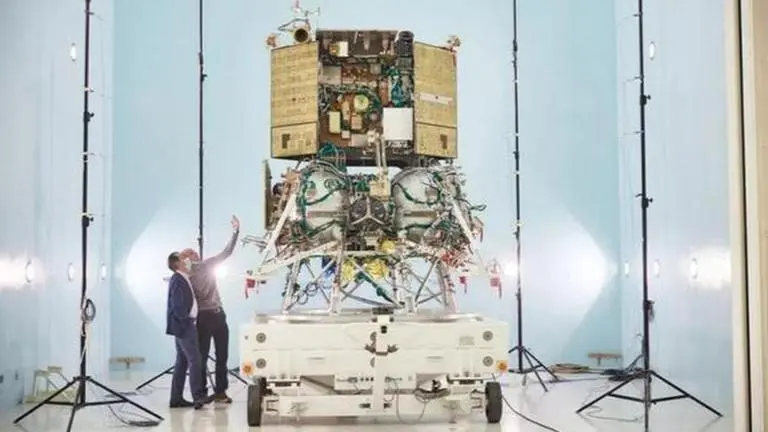
In a key development, Russia will launch its Luna-25 probe to the Moon by the end of September this year, Dmitry Rogozin, head of the Russian space agency Roscosmos informed on Tuesday, May 31. According to Russian media agency TASS, Rogozin hoped all tests to be successful for the mission which would witness the first Russian spacecraft land on the Moon. Originally planned to take off in July 2022, the mission got delayed after the European Space Agency (ESA), Roscosmos' partner, suspended cooperation over Russia's invasion of Ukraine.
In fact, ESA announced back in April that it is also terminating cooperation with Russia on Luna-26 and Luna-27, the successors of the Luna-25 joint mission.
The Luna-25 mission

(Illustration of the Luna-25 lander; Image: NASA)
Roscosmos is aiming to land an autonomous probe, fitted with a European-made navigation camera called PILOT-D, on the south pole of the Moon. Since ESA is out of the picture, Roscosmos will try to equip the landing probe with an indigenously made camera for navigation. The camera was already deployed on the lander to which ESA Director-General Josef Aschbacher said as per Space News, "I have already communicated this decision to the head of Roscosmos and also to request this instrument be put into safe storage until it can be returned to ESA".
Advertisement
As for the objectives of the Luna-25 mission, there are basically two- studying the composition of the polar regolith and studying the plasma and dust components of the lunar polar exosphere. The four-legged probe is equipped with landing rockets and propellant tanks, an upper compartment that holds the solar panels, communication equipment, and onboard computers. Weighing about 800 kilograms, the lander will launch in a Soyuz Fregat and is estimated to be operational for one year.
The Luna-25 will be followed by Luna-26 and Luna-27, which were also supposed to be conducted through the Russia-Europe partnership. According to ESA, the Luna-26 was targeted for launch two years later to install an orbiter into the lunar orbit for remote scientific measurements and as a possible communications relay for the next lander mission. The third and final mission, Luna-27 would have launched a year after its predecessor and was planned to be much bigger in size. Luna-27 too was a landing mission and according to ESA, the lander would have studied the composition of the soil near the lunar south pole.
Advertisement
Published By : Harsh Vardhan
Published On: 31 May 2022 at 16:52 IST