
Russia's Lunar Mission Luna-25 activates devices, transmits first data to Earth
Moscow's first lunar mission in post-Soviet space history which was launched after 47 years, took off on a Soyuz rocket from the Vostochny facility.
- Science News
- 3 min read

Russia's Luna-25 lunar mission's devices on Sunday, August 13 were activated and conducted their first measurements on the lunar surface prompting Russian scientists to process the first data received, the Russian space corporation Roscosmos said. "Today the scientific equipment, developed by the Russian Academy of Sciences' Space Research Institute, was switched on for the first time in the conditions of space flight," Roscosmos' official statement read. It added that the telemetry information from all the devices on the spacecraft indicates that the rocket is functioning nominally.
"The data gathered by the station on its way to the Moon has already been received, and the project's scientific team has begun processing it," according to Roscosmos. "Luna-25 continues its flight to the Earth's natural satellite - all systems of the automatic station are working properly, communication with it is stable, and the energy balance is positive," Roscosmos said in the statement it published on the Telegram messaging app.
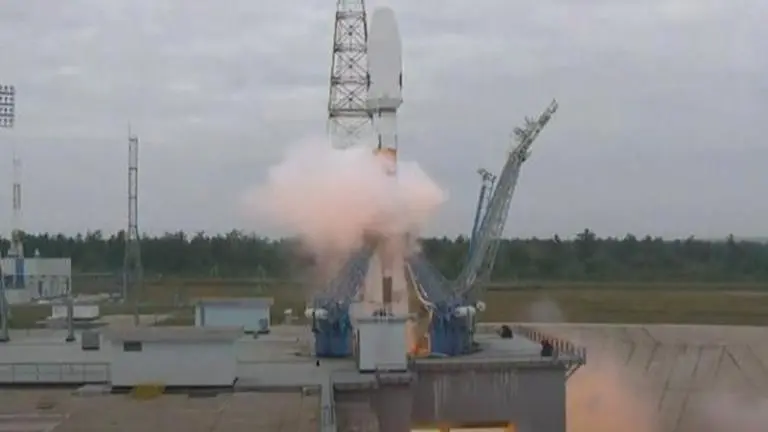
Moscow's first lunar mission in post-Soviet space history which was launched after approximately 47 years, took off on a Soyuz rocket from the Vostochny launch facility on August 11 in eastern Russia. It is also the first time that Russia has moved away from the Kazakhstan launch site, which hosts Baikonur Cosmodrome.

In this photo taken from video and released by Roscosmos State Space Corporation, the Soyuz-2.1b rocket with the moon lander Luna-25 automatic station takes off from a launch pad at the Vostochny Cosmodrome in the Russia’s Far East. Credit: Roscosmos State Space Corporation via AP
Advertisement
Lander to touch down 95-km wide Boguslawsky Crater on Aug 21
The lander is expected to touch down near the 95-km wide Boguslawsky Crater at the South Pole of the Moon on August 21 where it will forage for valuable water ice. If successful, the Russian mission would be the first ever to land in that region of the moon. It will prompt several other countries and private companies to send their mission. It is expected for the rocket to take five days to reach a 100-kilometre orbit around the Moon.
The lander was launched with a mass of 1,800 kg and is expected to enter lunar orbit on August 16, according to Roscosmos. Carrying the 31 kg payloads, it will drill lunar samples to analyse the lunar soil, study the lunar exosphere and radiation levels and take pictures of its surroundings over the course of one year (its lifespan). The south pole of the Moon is believed to have vast deposits of ice in Boguslawsky Crater which could be used for the production of fuel and oxygen during long-term missions. India’s Chandrayaan-3 mission will also attempt to land in the South region of the moon on August 23, while China will send its own rover there in 2026. NASA’s Artemis programme is also focusing on the South pole. Luna 25 is “an opportunity to steal the march on other people get some positive publicity,” Roger Launius, NASA’s former chief historian said.