
Saturn reclaims its 'Moon crown', becomes 1st known planet with more than 100 Moons
Saturn lost the title to Jupiter, which has 95 known Moons, in February this month after scientists found 12 new ones orbiting the gas giant.
- Science News
- 2 min read

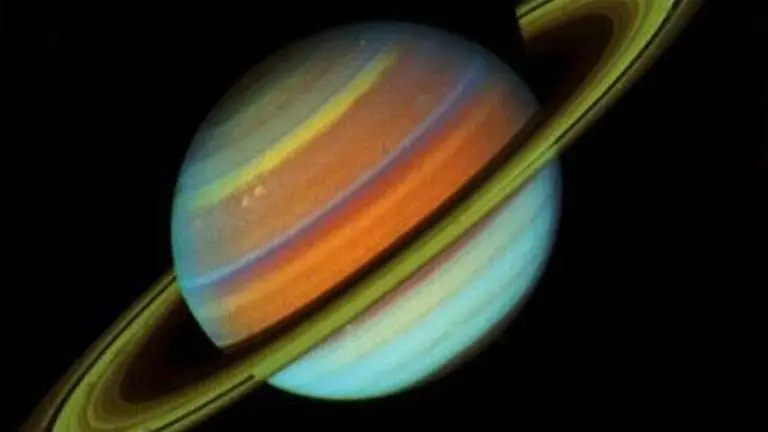
After being briefly overtaken by Jupiter, Saturn has reclaimed its title of the planet with the most Moons. Astronomers have discovered 62 new Moons around the ringed planet which takes the total number to 145. This has made Saturn the first known world in the universe with more than 100 Moons orbiting it. Saturn lost the title to Jupiter (95 Moons) in February this month after scientists found 12 new ones orbiting the gas giant.
Astronomers find 62 'irregular' Moons around Saturn
The new Moons orbiting Saturn are said to be 'irregular' ones, meaning they were captured by the planet's gravity and have a more inclined orbit as compared to the regular ones. An object is recognised as a Moon by the International Astronomical Union (IAU) if it fulfils the criteria such as size, orbit and gravitational pull set by the organisation. This is the organisation which demoted Pluto as a planet and instead calls it a 'dwarf-planet' since it does not fulfill the criteria to be called a planet.
As for the new Moons of Saturn, they were discovered by a an international team of astronomers led by Edward Ashton, a postdoctoral fellow at the Academia Sinica Institute of Astronomy and Astrophysics. The Moons were discovered using the method called 'shift and stack'.
In this method, images are shifted at the rate that the moon is moving across the sky. This results in the enhancement of the Moon's signal when all the data is combined, allowing moons that were too faint to be seen in individual images to become visible in the 'stacked' image.
Advertisement
This capturing and shifting of images was done using the data that was collected using the Canada-France-Hawaii Telescope (CFHT) on top of Mauna Kea, Hawaii between 2019 and 2021. This method allowed the astronomers to find a Moon having a diameter of just 2.5 kilometer. "As one pushes to the limit of modern telescopes, we are finding increasing evidence that a moderate-sized moon orbiting backwards around Saturn was blown apart something like 100 million years ago," said Brett Gladman from the University of British Columbia in an official statement.