
Saturn's rings are disappearing; here's how long it would last according to scientists
Saturn's rings are composed of billions of chunks of water ice, which have sizes ranging from that of a grain of sand to the size of a mountain, says NASA.
- Science News
- 2 min read

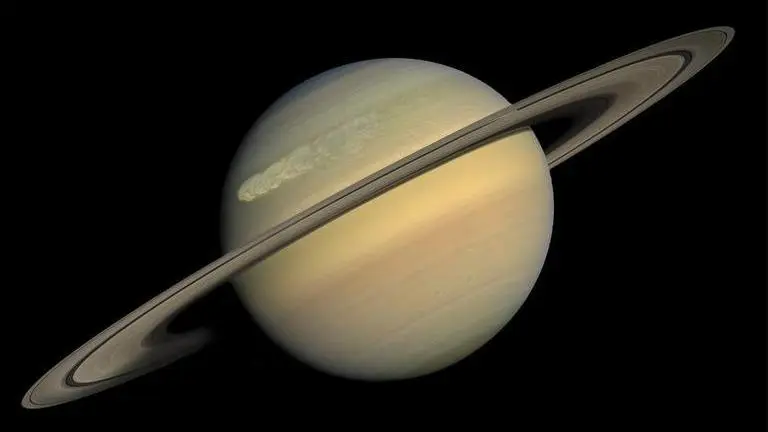
Among the planets in our solar system, Saturn is arguably the most pleasant to look at thanks to the magnificent rings surrounding it. Ever since we got a close look at Saturn, courtesy of NASA’s Voyager spacecraft, the rings have been a visual treat to stargazers. However, scientists fear that those stare-worthy rings might not last too long as they have been found to be disappearing, a phenomenon that has been explained by Japan Aerospace Exploration Agency (JAXA) scientist James O’Donoghue.
Exploring Saturn's rings
NASA explains that Saturn's rings are composed of billions of chunks of water ice, which have sizes ranging from that of a grain of sand to the size of a mountain. the rings are one of the three primary components of the Saturn system. The rings, along with Saturn's moons are a primary component of the planet's system and are generally about 30 feet (10 meters) in thickness. The Cassini spacecraft, which reached Saturn in 2004, found that much of the material in Saturn’s E-ring, a diffuse ring outside of the bright, main rings, was a result of water jets emerging from the moon Enceladus.
What is causing Saturn's rings to disappear?
In an interview with The Atlantic, O’Donoghue explained that the rings are disappearing due to the electrification of the dusty matter, something which is caused by disturbance due to micrometeorites and the sun’s radiation. Once electrified, these particles then get aligned with Saturn’s magnetic field lines. In the next step, these electrified particles get too close to the top of Saturn's atmosphere following which Saturn's gravity pulls them into the planet's clouds.
The continuation of this process, which scientists call 'ring rain', would cause the rings to vanish in the next few million years. O’Donoghue says that the rings would last for 300 million more years at the most. While scientists previously thought that the rings formed with Saturn about 4.6 billion years ago, data from the Cassini spacecraft revealed that they could not be more than 10 million to 100 million years old.