
Scientists discover 'monster black hole' nearly 12 times bigger than Sun
In a major development, scientists University of Alabama has located a new massive black hole whose mass is around twelve times that of the Sun.
- Science News
- 3 min read

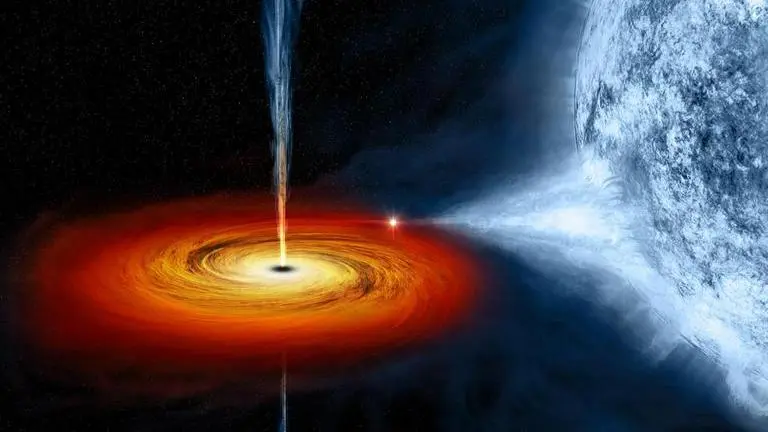
In a major development, scientists have located a new massive black hole whose mass is around twelve times that of the Sun. The new black hole was found by a team of astronomers led by the University of Alabama in Huntsville (UAH) and published on October 19. According to scientists, the massive region seems closer to the Sun than other celestial bodies. It is worth noting the American Space Agency- NASA describes a black hole as a place in space where gravity pulls so much that even light can not get out. Gravity is so strong because matter has been squeezed into a tiny space. This can happen when a star is dying.
Because no light can get out, people can't see black holes. They are invisible. Space telescopes with special tools can help find black holes. The special tools can see how stars that are very close to black holes act differently than other stars, according to NASA. The discovery of a so-called "Monster black hole" is published in a new Astrophysical Journal research, which is led by author Dr Sukanya Chakrabarti, a physics professor at The University of Alabama in Huntsville (UAH).
Monster black hole is discovered nearly 1,550 lights years
As per the professor, the newly discovered black hole is placed at a distance of 1,550 light-years-- the distance that light travels in one year, about 9.4607×10¹² kilometres. “It is closer to the sun than any other known black hole, at a distance of 1,550 light years. So, it's practically in our backyard. In some cases, like for supermassive black holes at the centres of galaxies, they can drive galaxy formation and evolution," said the lead author. “It is not yet clear how these noninteracting black holes affect galactic dynamics in the Milky Way. If they are numerous, they may well affect the formation of our galaxy and its internal dynamics," she added.
To find the black hole, Dr Chakrabarti and a national team of scientists analysed data from nearly 2,00,000 binary stars released over the summer from the European Space Agency’s Gaia satellite mission. “We searched for objects that were reported to have large companion masses but whose brightness could be attributed to a single visible star,” she says. “Thus, you have a good reason to think that the companion is dark.”
Advertisement
If Black Holes Are "Black," How Do Scientists Know They Are There?
According to NASA, a black hole can not be seen because strong gravity pulls all of the light into the middle of the black hole. But scientists can see how strong gravity affects the stars and gas around the black hole. Scientists can study stars to find out if they are flying around, or orbiting, a black hole. When a black hole and a star are close together, high-energy light is made. This kind of light can not be seen with human eyes. Scientists use satellites and telescopes in space to see high-energy light.