
Updated 12 August 2020 at 14:43 IST
Scientists say Ceres' future exploration can reveal potential habitability
A planetary scientist at Caltech Castillo-Rogez concluded that Ceres was now a confirmed ocean world with deep brines that opens scope of further research.
- Science News
- 3 min read

Scientists have found that after the discovery of salty reservoirs on the dwarf planet Ceres, another ten years of exploration of the asteroid belt between Mars and Jupiter rich in organic matter can reveal its evolution and potential habitability. Previously concluded to have been composed of massive rocks, the planet was found to contain a large salty reservoir of seas, according to the results of a major exploration.
A planetary scientist at Caltech, Dr. Julie Castillo-Rogez concluded that Ceres was now a confirmed ocean world with deep brines at a regional and potentially global scale. He concluded that the planet's potential for habitability can be unravelled with further data accumulation and research missions in the coming years with the landmark finding of fluids. These key findings were made after NASA’s Dawn spacecraft accumulated the surface data and high-resolution images of the dwarf planet. The paper published in the journals Nature Astronomy, Nature Geoscience, and Nature Communications also made other key discoveries about the first member of the asteroid belt found by Giuseppe Piazzi spotted it in 1801.
Further studies of Ceres’ conditions and – above all – a follow-up mission are needed to study its evolution and potential habitability—Julie Castillo-Rogez, Caltech, NASA said in the report.

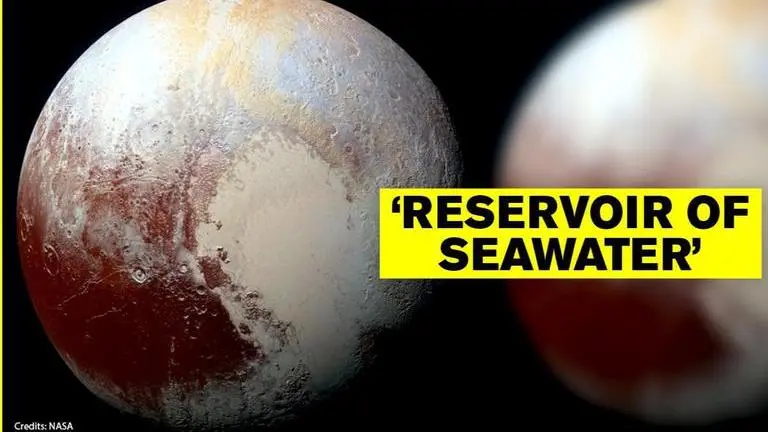
[NASA’s New Horizons probe snapped the first-ever close-up images of Pluto. Scientists continue to be stunned by its unexpectedly complex surface features. Credit: NASA/JHUAPL/SRI]

[NASA's Dawn spacecraft has revealed many landslides on Ceres, which researchers interpret to have been shaped by a significant amount of water ice. Image credit: NASA/JPL-Caltech/UCLA/MPS/DLR/IDA]
Advertisement
Advertisement
According to scientists, the large reservoir on the dwarf planet is located beneath a nearly 20-million-year-old crater known as Occator. A team from the California Institute of Technology studied images captured from NASA’s Dawn spacecraft that orbited Ceres. However, unfortunately, the spacecraft had to terminate after 20 miles journey due to a shortage of fuel between 2015 and 2018. But the orbiter was able to perform imaging, scanning, and gravity analysis of the Occator crater before it went off. Therefore, basis the images it surveyed, scientists concluded the presence of the humungous seas on the planet than previously thought rock structure after spotting ‘bright spots’ on Ceres’ surface.

[This orthographic projection shows dwarf planet Ceres as seen by NASA's Dawn spacecraft. Image credit: NASA/JPL-Caltech/UCLA/MPS/DLR/IDA]
A deputy principal investigator of the mission, Dr. Carol Raymond, said in the study, “It suggests Ceres is an ocean world and may have been geologically active in the recent past." Further, he added, “The existence of a deep-seated brine reservoir beneath Occator is supported by recent results from gravity data.”As per the research analysis of the surface of the dwarf planet, scientists claimed that Salt was responsible to reduce the temperature of the fluid to the freezing point, and therefore, detection of chloride salts – commonly found in sea ice established the findings. The surface was thoroughly studied using visible and infrared light.
Salty fluids maintain temperatures
Another lead author at the National Institute of Astrophysics in Rome Maria Cristina De Sanctis said, “The spatial distribution suggests chloride salts are the solid residue of deep brines that reached the surface in the last two million years – or are still ascending.” She added, “These salts are very efficient in maintaining Ceres’ warm internal temperature and lowering the temperature of the brines – in which case ascending salty fluids may exist today.”
Published By : Zaini Majeed
Published On: 12 August 2020 at 14:43 IST