
Google marks Stephen Hawking's 80th birthday with animated doodle, narration in his voice
Google has unveiled its unique animated doodle which is showcasing the cartoonish image of Stephen Hawking along with an illustration of an universe
- Science News
- 2 min read

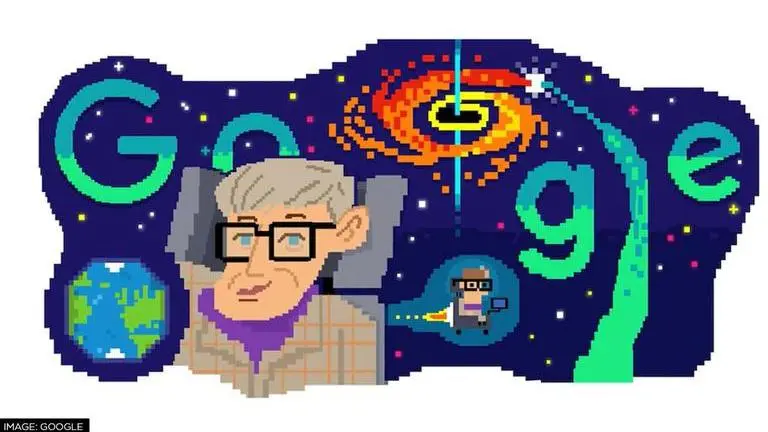
On the 80th birth anniversary of the English theoretical physicist, cosmologist, Stephen William Hawking, Google has unveiled its unique animated doodle which is showcasing the cartoonish image of the scientist along with an illustration of a yellow-orange universe. With a two-and-a-half-minute animation video, Google has paid a tribute to Hawking on his birth anniversary.
When one clicks on Stephen Hawking’s doodle on its home page, it opens with the animated video which is narrated in Hawking's special computer-generated voice that highlights his discoveries, contributions as well as achievements to the cosmos. It also shows his life-long fight with neurological illness.
Take a look at the Stephen Hawking Google doodle:
Stephen Hawking is one of the most well-known scientists of this generation, with his groundbreaking ideas on black holes and the Big Bang Theory. Hawking was also an author, whose best-selling books made modern science approachable to millions of readers throughout the world, in addition to his contributions to the discipline.
Advertisement
Stephen Hawking: A man captivated by the cosmos
Stephen Hawking was born on January 8, 1942, in Oxford, England, was always captivated by the cosmos. He started his academic career in October 1959, at the age of 17, at University College, Oxford, where he got a first-class BA physics degree. He was diagnosed with a neurodegenerative condition at the age of 21, which restricted him to a wheelchair for a lifetime. Slowly, he lost his ability to speak and had to rely on a speech-generating gadget to communicate.
Hawking began his professional career as a research fellow at Gonville and Caius College in Cambridge. He had a fascination with black holes, which he used as the basis for his research and investigations. In the year 1974, he found that particles can escape black holes, with the radiation visible outside the cusp of the black hole being named after him, Hawking Radiation, which is regarded as his most significant contribution to science.
Advertisement
Hawking's studies on black holes led to his selection as the Lucasian Professor of Mathematics at Cambridge in 1979, a post which was previously held by Isaac Newton in 1669. In 2017, Hawking's Ph.D. thesis was made available to the public on a University of Cambridge website, which crashed due to high demand. In 2018, he passed away at the age of 76.
(Image: Google)