
Updated 30 March 2023 at 17:26 IST
Strong solar flare erupts from the Sun, causes radio blackout in parts of Asia & Oceania
In its seventh such event this year, the Sun emitted a strong solar flare, peaking at 10:33 pm ET on March 28, 2023, reported NASA’s Solar Dynamics Observatory.
- Science News
- 3 min read

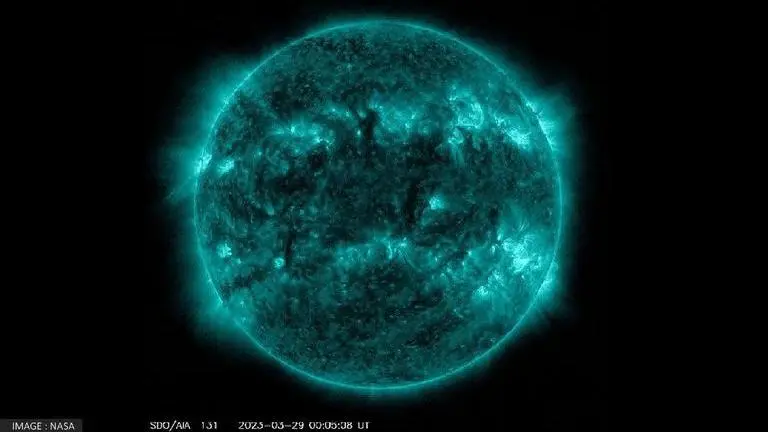
According to NASA, a powerful solar flare was discharged by the Sun at 10:33 p.m. ET on March 28, 2023. The event was recorded by NASA's Solar Dynamics Observatory, which monitors the Sun continuously. The solar flare that occurred on Monday has been classified as an X1.2 flare, with X-class indicating the most powerful flares and the number providing further details about its intensity.
A shortwave radio blackout occurred over southeast Asia, Australia, and New Zealand when the solar flare from the Sun ionised the uppermost layer of Earth's atmosphere. The flare originated from sunspot AR3256, located near the southwestern edge of the star in our Solar System.
According to Spaceweather.com, Monday's solar flare resulted in the ionisation of the atmosphere and causing disruptions in signal propagation and reception below 30 MHz. These effects may have been noticeable to Ham radio operators.
The respite is over. A growing X-flare player on the solar disk is causing radio noise to increase on Earth's dayside. #RadioBlackouts are once again on the menu due to region 3256. We just got a short-duration X-class flare (R3-level) & a non-Earth directed #solarstorm launch. https://t.co/W7WLcC871W
— Dr. Tamitha Skov (@TamithaSkov) March 29, 2023
In a span of just three months in 2023, the Sun has produced seven similar explosions, which is equivalent to the total number of flares recorded in 2022. This suggests a significant increase in solar activity, as the Sun progresses through its solar cycle and approaches peak activity.
Advertisement
During the past week, a significant plasma explosion occurred high above the surface of the Sun, reaching a height equivalent to 14 Earths stacked on top of each other. This event was accompanied by four notable solar flares, 22 coronal mass ejections, and a geomagnetic storm triggered by the Sun.
What are solar flares?
Solar flares are intense and sudden bursts of radiation that emanate from the Sun's surface. They are caused by the sudden release of magnetic energy that has built up in the Sun's atmosphere.
Advertisement
Solar flares can affect people on Earth in several ways. They can disrupt radio communications by causing ionisation in the Earth's upper atmosphere, which can interfere with radio signals. This can affect GPS and other communication technologies that rely on radio signals.
They can also cause blackouts in electrical power grids. The radiation emitted by solar flares can interfere with power lines, transformers, and other equipment, causing them to fail. This can lead to widespread power outages, which can last for hours or even days.
Moreover, solar flares can pose a risk to astronauts and spacecraft by exposing them to high levels of radiation. The charged particles released during solar flares can cause damage to spacecraft and even affect the health of astronauts who are outside the Earth's protective atmosphere.
Solar flares can have significant impacts on various technologies and systems on Earth, which can affect daily life and even pose risks to people and infrastructure.
Published By : Digital Desk
Published On: 30 March 2023 at 17:26 IST