
Venus' clouds comprising ammonia might allow life to thrive, suggests new study
A new study conducted by experts from three universities suggests that if life were to ever exist on Venus, the clouds would have been the most likely place.
- Science News
- 3 min read

;'%3e%3cpath%20d='m8,15.99c4.41,0,7.99-3.58,7.99-7.99S12.41,0,8,0,0,3.59,0,8s3.58,7.99,7.99,7.99Z'%20style='stroke:%23fff;%20stroke-miterlimit:10;%20stroke-width:.02px;'/%3e%3cpath%20d='m3.08,3.37l3.82,5.11-3.84,4.15h.87l3.37-3.64,2.72,3.64h2.94l-4.04-5.39,3.58-3.87h-.86l-3.1,3.35-2.5-3.35h-2.94Zm1.27.64h1.35l5.97,7.99h-1.35l-5.97-7.99Z'%20style='fill:%23fff;'/%3e%3c/g%3e%3c/svg%3e)


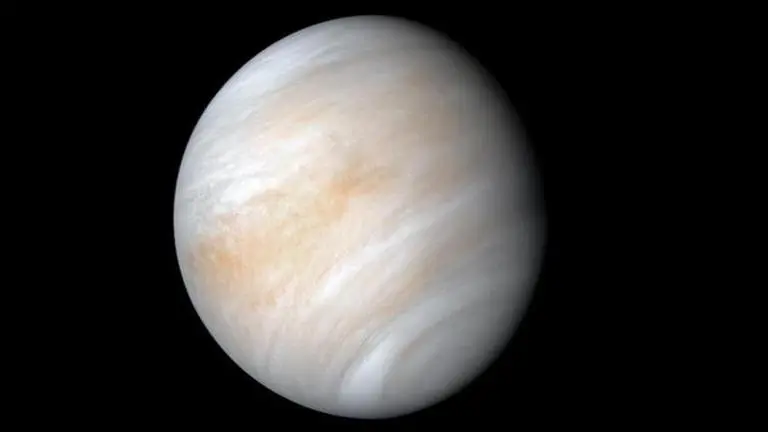
A new study conducted by experts from three universities has suggested that if life were to ever exist on Venus, the clouds would have been the most likely place. The second planet in our solar system is known to house a hostile environment with an atmosphere thick with carbon dioxide, and a surface hot enough to melt lead. However, researchers have now identified a chemically-induced method by which life could neutralise Venus’ acidic environment, creating a self-sustaining, habitable pocket in the clouds.
It's hard to imagine a more inhospitable world than our nearest planetary neighbour. And yet, a new study suggests that if life on Venus exists, it might make its home in the clouds. @EarthSciCam @DeptofPhysics @MIT https://t.co/VE20unZWTq
— Cambridge University (@Cambridge_Uni) December 21, 2021
Ammonia found to be the life-ingredient
Venus was first found to contain ammonia, a mixture of nitrogen and hydrogen, in its atmosphere in the 1970s. Now, researchers from MIT, Cambridge University and Cardiff University have found that it is the same ammonia that could serve as the new ingredient for life. In their new study, which has been published in the Proceedings of the National Academy of Sciences, the scientists explained through a model of chemical processes that if ammonia is indeed present, it could trigger chemical reactions that will neutralise surrounding droplets of sulphuric acid in the atmosphere. Co-author Sara Seager, from MIT, said as per Cambridge University’s report-
Ammonia shouldn’t be on Venus. It has hydrogen attached to it, and there’s very little hydrogen around. Any gas that doesn’t belong in the context of its environment is automatically suspicious for being made by life.
It is worth mentioning that ever since the detection of ammonia, scientists have believed that it couldn’t have been produced through any chemical process known on Venus. The study explains that once the sulphuric acid is neutralised, the chemistry could allow the birth of life in the clouds. It is also pertinent to mention that according to scientists, even the origin of Venus’ ammonia is the result of a biological process as opposed to lightning or volcanic eruptions. Shedding more light on the study, Seager further said as per Cambridge University-
No life that we know of could survive in the Venus droplets. But the point is, maybe some life is there, and is modifying its environment so that it is livable.
The theory of life being present on Venus has also been debated over in the past after scientists detected traces of phosphine on the planet, a gas produced mainly through biological interactions. While much remains to be studied for further confirmations, the researchers said that their theory will soon be tested after the Life Finder mission bound to Venus launches in 2023.