
Why is Milky Way's supermassive black hole named Sagittarius A*? Read here to know
The supermassive black hole is located about 27,000 light-years away from the Earth and is four million times more massive than the sun.
- Science News
- 3 min read

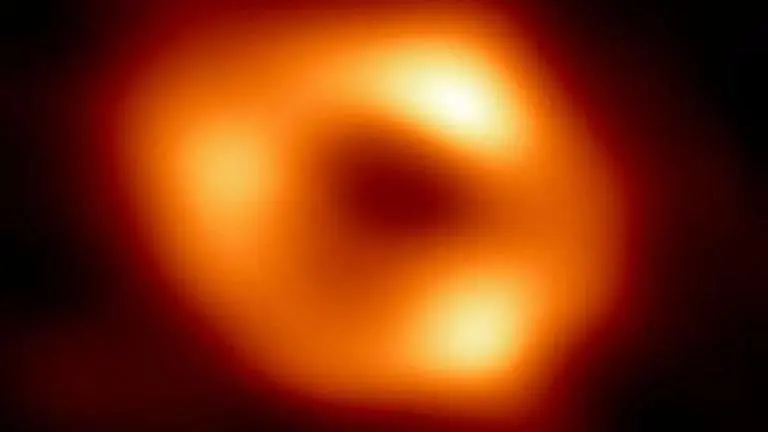
May 12 turned out to be a historic day as astronomers released the first-ever image of the supermassive black hole residing at the center of our galaxy, the Milky Way. The photograph is a result of observations by over 300 scientists and a network of eight major observatories around the world. Located about 27,000 light-years away from Earth, the behemoth has been named Sagittarius A* (star) and is four million times more massive than the sun.
📢 Breaking news: Meet the Black Hole at the Centre of our Galaxy! Astronomers have unveiled the 1st image of the supermassive black hole at the centre of the Milky Way. The image was produced by a global research team @ehtelescope 📷EHT Collaboration pic.twitter.com/xcB3qt4La4
— ESO (@ESO) May 12, 2022
Why is the black hole named Sagittarius A* (star)?
Astronomers have named the Milky Way's supermassive black hole Sagittarius A* because of its location in the Sagittarius constellation. The European Southern Observatory (ESO), one of the contributors to imaging the black hole, shared a video wherein the astronomers zoom into the Sgr A* constellation. Notably, the image does not show the black hole itself, since these objects do not allow light to escape away from them. Rather, it depicts a dark central region, called a shadow, surrounded by a bright ring-like structure that actually are glowing gases around the black hole. The picture also shows light being bent around the black hole due to an overwhelmingly strong gravitation pull.
🔵 Scientists had previously seen stars orbiting around something invisible, compact & very massive at the centre of the #MilkyWay. This suggested that this object is a black hole & today’s image provides the first direct visual evidence of it. Say hello to #OurBlackHole👋 pic.twitter.com/UvU4ERkeiU
— ESO (@ESO) May 12, 2022
Notably, the collaboration brought together 300 researchers from 80 institutes around the world under the Event Horizon Telescope (EHT) collaboration and the astronomers used eight different existing radio observatories across the world. "The EHT observed Sgr A* on multiple nights in 2017, collecting data for many hours in a row, similar to using a long exposure time on a camera," the ESO said in a statement.

(Image: ESO)
Advertisement
The telescopes involved in the observations were the Atacama Large Millimeter/submillimeter Array (ALMA), the Atacama Pathfinder Experiment (APEX), the IRAM 30-meter Telescope, the James Clerk Maxwell Telescope (JCMT), the Large Millimeter Telescope Alfonso Serrano (LMT), the Submillimeter Array (SMA), the UArizona Submillimeter Telescope (SMT), the South Pole Telescope (SPT).

(Image: ESO)
Advertisement
Milky way's Vs Messier 87's supermassive black hole

So far, the astronomers have obtained two direct images of supermassive black holes, one in the Milky Way and the other in the Messier 87 galaxy which was photographed in 2019. While photographs of both the objects look similar, there is a significant difference in their size. Compared to the Sgr A*, the M87's supermassive black hole is a whopping 6.5 billion times the mass of the sun and is located about 55 million light-years from Earth. According to astronomers, if Sgr A* was the size of a donut, the M87 would be the size of a soccer stadium.