
Why Uranus & Neptune have similar traits but different colours? Study presents new theory
Uranus and Neptune both have near-identical traits in terms of mass and atmospheric composition yet have different colours. Scientists may finally know why.
- Science News
- 3 min read

;'%3e%3cpath%20d='m8,15.99c4.41,0,7.99-3.58,7.99-7.99S12.41,0,8,0,0,3.59,0,8s3.58,7.99,7.99,7.99Z'%20style='stroke:%23fff;%20stroke-miterlimit:10;%20stroke-width:.02px;'/%3e%3cpath%20d='m3.08,3.37l3.82,5.11-3.84,4.15h.87l3.37-3.64,2.72,3.64h2.94l-4.04-5.39,3.58-3.87h-.86l-3.1,3.35-2.5-3.35h-2.94Zm1.27.64h1.35l5.97,7.99h-1.35l-5.97-7.99Z'%20style='fill:%23fff;'/%3e%3c/g%3e%3c/svg%3e)


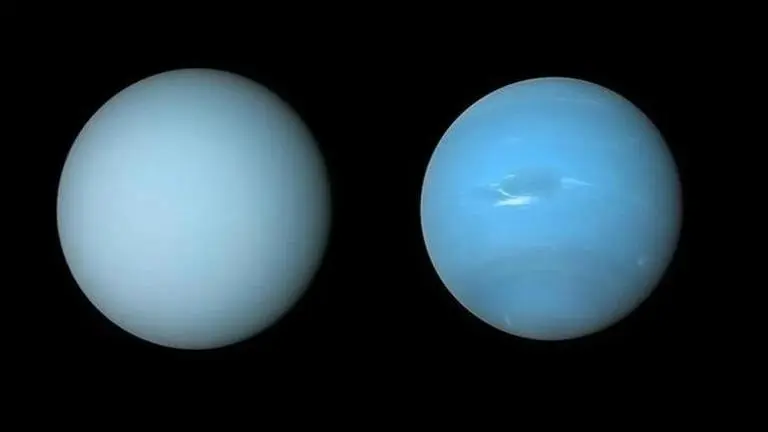
Far away from planet Earth, exist two icy giants- Uranus and Neptune. While the two have near-identical characteristics, both the planets have a different appearance when it comes to the colour of their atmosphere. However, new research which dived deep into the subject claims to have found the answer.
Uranus vs Neptune
Before understanding the reason for the difference in their colours, first, let us compare the atmospheric characteristics of the two planets. Starting with their mass, both the planets are close to one another. Uranus has a mass which is approximately 15 times greater than the Earth whereas Neptune’s mass is 17 times higher than our planet. Their atmospheres also have similar compositions as they are predominantly composed of helium, methane and hydrogen, the last one being 80% on both the planets. Notably, none of the planets has a true surface as most of them are basically swirling fluids.
What causes the colour difference in planets?

(Comparison of Uranus and Neptune's atmosphere; Image: NASA)
According to a study published in the journal Advancing Earth and Space Science, a build of excess haze in the stagnant and sluggish atmosphere of Uranus gives it a lighter tone than Neptune. The study is based on observations by the Gemini Observatory, and Hubble telescope along with others, under a project of the National Science Foundation's National Optical-Infrared Astronomy Research Laboratory (NOIRLab). This conclusion was derived after the study experts developed a model to describe aerosol layers in the atmospheres of Neptune and Uranus.
Advertisement
In the previous theories, astronomers had suggested that Neptune is bluer in colour due to the higher reflection of blue light and absorption of red light, a process triggered by methane in the planet's atmosphere. However, another argument was that Uranus has a slightly higher amount of methane in its atmosphere than Neptune, which made scientists find an answer to this discrepancy.
In the new study, experts have noted that previous investigations only focused on the appearance of the atmosphere at only specific wavelengths. The new model, on the other hand, which shows multiple atmospheric layers (as shown in the image above) matches observations from both planets across a wide range of wavelengths. The experts explained that the layer which tones down the colour in Uranus is the Aerosol-2 layer. They further said that the methane ice likely condenses onto the particles in this layer, pulling the particles deeper into the atmosphere in a shower of methane snow. And since Neptune’s atmosphere is more efficient at producing the snow, the snowfall removes most of the haze and does not block the blue colour.
Advertisement
"We hoped that developing this model would help us understand clouds and hazes in the ice giant atmospheres", Mike Wong, an astronomer at the University of California, said in a statement. "Explaining the difference in colour between Uranus and Neptune was an unexpected bonus".